Hydrosphere - How it Sustains Human Life?
Posted 6 months ago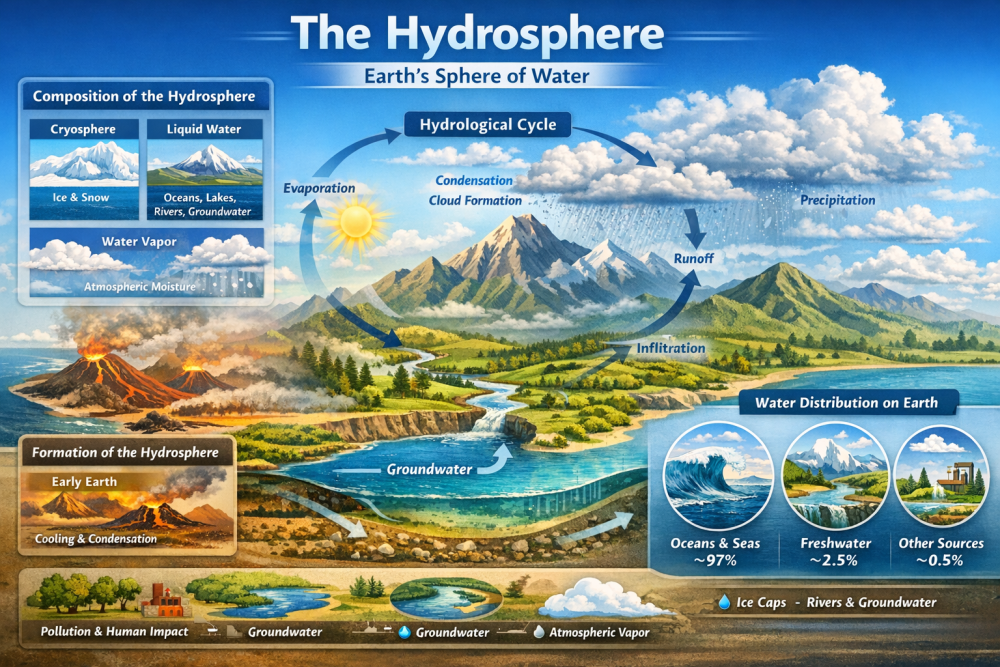
EH-5
The term hydrosphere comes from the Greek words hydro (water) and sphere (sphere), meaning “sphere of water.” This concept includes all forms of water on Earth, such as vast oceans and seas, flowing rivers, calm lakes, underground aquifers, ice caps and glaciers, and water vapor in the atmosphere. Therefore, the hydrosphere isn't limited to visible water bodies; it extends into the atmosphere and the lithosphere, forming a continuous, interconnected global system.
The core of the hydrosphere is its active nature. Water constantly moves and changes through the water cycle, a process powered by solar energy and gravity. This cycle influences climate and weather patterns by redistributing heat and moisture across the globe, affecting regional climates and weather events. Through evaporation, water from oceans, lakes, and soil turns into vapor and rises into the atmosphere. This vapor then condenses to form clouds and eventually falls back to Earth as precipitation, rain, snow, or hail. Processes like infiltration, runoff, and freezing help distribute water across different reservoirs. This ongoing cycle not only keeps water in its various forms, solid, liquid, and gas, in balance but also plays a crucial role in controlling Earth’s climate, redistributing heat, and shaping the planet’s surface.
The hydrosphere is closely connected with the biosphere because it provides the essential environment for all known life forms. From tiny aquatic organisms to complex land ecosystems, water is vital for bodily functions, nutrient delivery, and ecological interactions. Despite Earth's large water resources, only a small portion is accessible as freshwater, which is critical for human consumption, agriculture, and industry. This scarcity highlights the importance of sustainable management and conservation efforts to ensure that freshwater remains available for future generations.
In recent centuries, human activities have become a major force altering the hydrosphere. Industrialization, urbanization, deforestation, and agricultural growth have caused more water extraction, pollution, and changes in natural water flows. For example, discharges of heavy metals, plastics, and chemical pollutants contaminate water sources, posing serious risks to ecosystems and human health. Additionally, human-caused climate change is intensifying the water cycle's disruptions, leading to more frequent and severe droughts, floods, and altered rainfall patterns. These impacts underscore the urgent need for sustainable water management practices to protect this vital resource.
From a compositional perspective, the hydrosphere includes water in all three physical states. Solid water, often called the cryosphere, comprises ice sheets in polar regions, mountain glaciers, permafrost, and seasonal snow cover. Liquid water exists as both freshwater and saltwater; freshwater is found in rivers, lakes, wetlands, and underground aquifers, while saltwater dominates the oceans and seas. Gaseous water, in the form of water vapor, is present in the atmosphere and is an essential component of weather and climate systems. Another useful classification considers the movement and location of water: lotic systems are characterized by flowing water, such as rivers and streams, whereas lentic systems include still bodies of water, such as lakes and ponds. Groundwater represents subsurface reservoirs, while atmospheric and cryogenic waters complete the broader categorization.
Regarding global distribution, the hydrosphere holds about 1.4 billion cubic kilometers of water. However, this large amount is not evenly distributed. Oceans and seas make up roughly 97% of Earth’s total water, so saline water is the most common. Freshwater accounts for only about 2.5% of the world's water, and most of it is stored in glaciers, ice caps, or deep underground. Less than 1% of freshwater is readily available in rivers, lakes, and shallow groundwater, the main sources for human use, farming, and industry.
In conclusion, the hydrosphere is a dynamic and life-sustaining system that integrates physical, chemical, and biological processes across the Earth. Its continuous movement through the hydrological cycle, its role in shaping landscapes, and its indispensable function in supporting life underscore its critical importance. However, the limited availability of usable freshwater, coupled with increasing anthropogenic pressures, necessitates responsible stewardship and sustainable management to ensure that this vital resource remains available for future generations.