Biosphere and Human Health: Structure, Components, and Functional Significance
Posted 6 months ago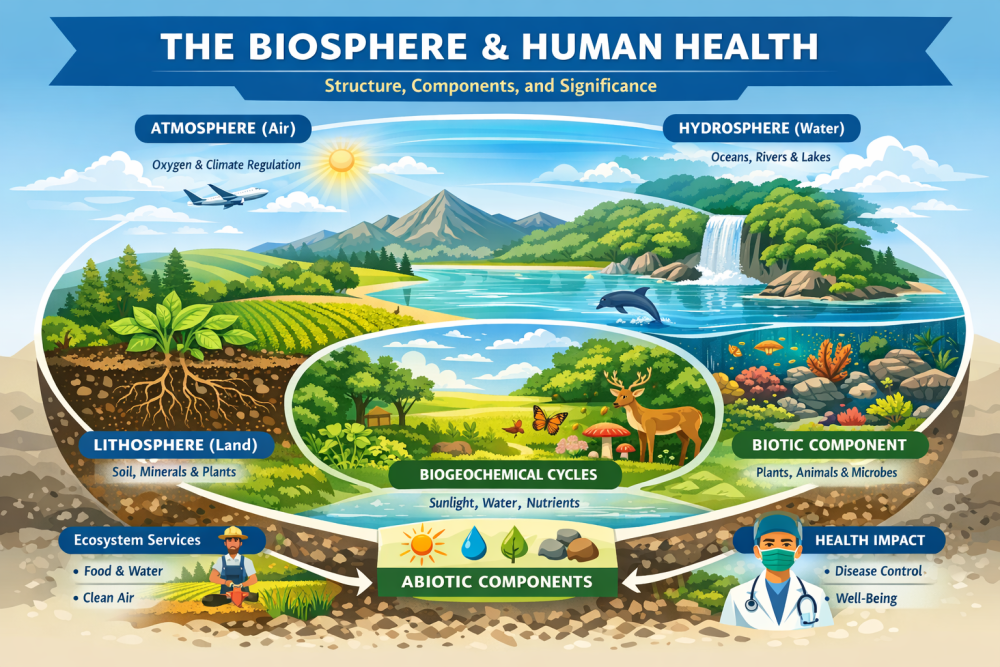
EH-6
1.0 Introduction
The biosphere is Earth's most extensive ecological system, including all living organisms and their interactions with the physical environment. It is often called the “zone of life” because it integrates biological communities with atmospheric, hydrological, and geological processes. According to biosphere definitions, it encompasses all ecosystems from deep ocean trenches to high mountain ranges, forming a thin yet active layer that supports life.
In human health contexts, the biosphere is not just a passive environment but an active system that supports life by managing air quality, water resources, food supply, and disease ecology. Understanding its structure and parts is therefore essential to environmental health sciences.
2.0 Origin and Evolution of the Biosphere
The biosphere began about 3.5 billion years ago, with simple life forms such as prokaryotes that thrived in oxygen-free environments. Over time, the rise of photosynthetic organisms changed Earth’s atmosphere by releasing oxygen, allowing more complex life to develop.
This evolutionary shift made the biosphere a self-regulating system, fueled by energy flow (mainly solar) and nutrient circulation. The relationship between living beings and their environment slowly built a stable ecological structure that can support biodiversity and human civilization.
3.0 Structural Organization of the Biosphere
The biosphere is a thin layer that extends roughly from a few kilometers into the atmosphere down to the deepest parts of the oceans. However, most of life is concentrated in a narrow zone where environmental conditions are optimal.
It is not an isolated system but overlaps with three major Earth spheres:
• Atmosphere (air)
• Hydrosphere (water)
• Lithosphere (land)
Intersecting regions of the atmosphere, hydrosphere, and lithosphere establish the conditions essential for life, highlighting the interconnectedness that should inspire respect and care.
4.0 Core Components of the Biosphere
4.1 Lithosphere (Land Component)
The lithosphere is Earth's solid outer layer, consisting of soil, rocks, and minerals. It provides:
• Physical support for terrestrial ecosystems
• Essential nutrients (e.g., nitrogen, phosphorus)
• Habitat for microorganisms and plants
The quality of soil within the lithosphere directly impacts human health by affecting food safety, agricultural productivity, and exposure to toxins, underscoring the importance of soil in environmental health sciences.
4.2 Hydrosphere (Water Component)
The hydrosphere includes all water bodies, including oceans, rivers, lakes, glaciers, and groundwater. It is vital because:
• Water is essential for all metabolic processes
• It regulates climate and temperature
• It supports aquatic biodiversity
Human health is closely tied to water quality; contamination can lead to infectious diseases and ecological imbalance.
4.3 Atmosphere (Air Component)
The atmosphere is the gaseous layer that surrounds Earth, made mostly of nitrogen and oxygen, with small amounts of other gases. Its functions include:
• Providing oxygen for respiration and carbon dioxide for photosynthesis
• Regulating temperature and climate
• Protecting life from harmful radiation
Air quality directly affects respiratory and cardiovascular health, so atmospheric stability is crucial for human well-being.
4.4 Biotic Component (Living Organisms)
The biotic component includes all living organisms, categorized into:
• Producers (plants, algae): convert solar energy into food
• Consumers (animals, humans): depend on other organisms
• Decomposers (bacteria, fungi): recycle nutrients
These interactions form food webs and nutrient cycles essential for ecosystem stability. Disruptions can lead to ecological imbalance and increased disease risks.
4.5 Abiotic Component (Non-Living Factors)
The abiotic component includes non-living elements such as:
• Sunlight (primary energy source)
• Temperature and climate
• Water and gases
• Nutrients and minerals
These factors control biological processes and influence the spread of life. They are vital for keeping ecological balance and supporting life systems.
5.0 Functional Dynamics of the Biosphere
The biosphere operates through interconnected processes such as energy flow and Biogeochemical Cycles, emphasizing the importance of understanding these functions to empower the audience to promote sustainability.
The biosphere operates through interconnected processes:
• Energy Flow: Solar energy drives photosynthesis and food chains
• Biogeochemical Cycles: Carbon, nitrogen, and water cycles sustain life
• Ecological Interactions: Predator-prey relationships, symbiosis, and competition
These processes ensure the biosphere remains a self-sustaining system in which matter is recycled, and energy flows continuously.
6.0 Biosphere and Human Health
The biosphere influences human health through pathways such as air and water quality, and disruptions, such as ecosystem imbalance, can increase zoonotic disease risks and alter pathogen transmission, highlighting the need for ecosystem stability.
The biosphere directly influences human health through multiple pathways:
6.1 Provisioning Services
• Food production from terrestrial and aquatic ecosystems
• Freshwater supply is essential for survival
6.2 Regulating Services
• Climate regulation and carbon sequestration
• Air and water purification
6.3 Disease Ecology
• Ecosystem imbalance can increase zoonotic diseases
• Biodiversity loss alters pathogen transmission dynamics
6.4 Nutritional and Medicinal Resources
• Plants and microorganisms serve as sources of medicines
• Soil and water quality influence nutritional value
7.0 Importance of the Biosphere
The biosphere is indispensable because it:
• Sustains all forms of life
• Maintains ecological balance
• Regulates climate and atmospheric composition
• Supports biodiversity and evolutionary processes
• Provides ecosystem services critical for human survival
8.0 Conclusion
The biosphere is a delicate, interconnected system in which living and non-living components work together to sustain life on Earth. Its main components, the lithosphere, hydrosphere, atmosphere, and biotic systems, operate in harmony to control environmental conditions vital for human health.
In an era of rapid environmental change, understanding the biosphere is not merely academic but a necessity for sustainable development and global health security. Protecting the integrity of the biosphere is ultimately synonymous with safeguarding human existence itself.