The Invisible War Pakistan Is Finally Learning to See
Posted 4 months ago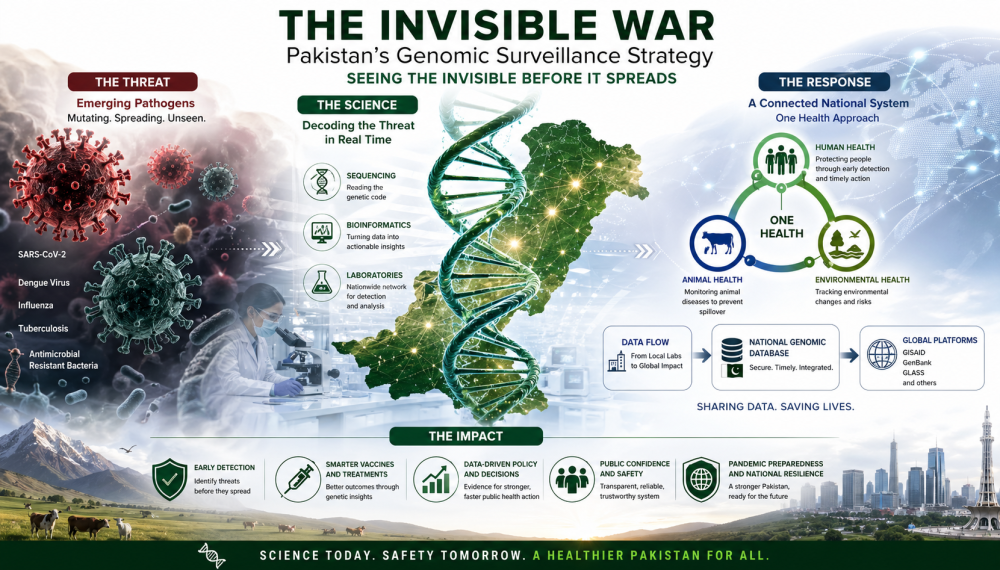
21/2026
A quiet revolution is taking shape in Pakistan, one that most citizens will never directly witness yet could determine the country’s health, security, and economic future. It is not happening in parliament or on television screens. It is unfolding in laboratories, in streams of genetic code, and in the careful tracking of microscopic enemies.
Pakistan’s National Genomic Surveillance Strategy for Priority Pathogens is, at its core, a plan to read the “DNA fingerprints” of viruses and bacteria before they spiral into crises. It may sound technical, even abstract, but in plain terms, it is about learning to spot a threat before it becomes a tragedy.
A Lesson Written in Loss
During the COVID-19 pandemic, countries that could quickly decode the virus’s genetic makeup, its mutations, and its spread and behavior had a decisive advantage. They could act faster, adapt vaccines, and prepare hospitals. Others were left reacting rather than preventing.
Pakistan, like many nations, learned this lesson the hard way.
The strategy document makes this point clear: genomic surveillance helps us understand how diseases spread, how they change, and how dangerous they might become. It is not just about science; it is about survival.
What This Strategy Really Means
At first glance, the document reads like a technical blueprint. It discusses sequencing, bioinformatics, and data repositories. But beneath the jargon lies a simple idea:
Don’t wait for an outbreak to explode. Detect it early, understand it quickly, and act decisively.
To achieve this, the plan focuses on five practical goals:
- Expand access to technology so every region, not just major cities, can detect diseases.
- Train skilled professionals who can analyze complex genetic data.
- Share information quickly across provinces and with global databases.
- Connect systems for human health, animal health, and environmental monitoring.
- Stay ready for emergencies, instead of scrambling when they arrive.
Each of these goals reflects a painful reality: Pakistan already has pieces of the system, but they are scattered, uneven, and often disconnected.
Data Sharing Power
One of the most striking aspects of the strategy is its emphasis on data sharing. Today, information about diseases often sits in silos within institutions, is delayed between provinces, or is unavailable.
The strategy calls for a national repository for genomic data, ensuring that information flows from local labs to national authorities and to global platforms such as GISAID and GenBank.
Why does this matter?
Because in public health, a delay of days can cost thousands of lives.
But data is also power, and power breeds hesitation. Concerns about ownership, misuse, and security are real. The document itself acknowledges issues such as a lack of trust and weak coordination.
This is where policy meets politics. Technology alone cannot solve a problem rooted in institutional culture.
One Health: A Broader Vision
Perhaps the most forward-looking aspect of the strategy is its embrace of the “One Health” approach, the recognition that human health is deeply connected to animal and environmental health.
Diseases do not respect boundaries. A virus emerging in livestock, a pathogen spreading through water systems, or a mutation triggered by environmental change can all spill over into human populations.
Pakistan, with its dense population, agricultural economy, and climate-related vulnerabilities, is especially exposed.
The strategy’s insistence on integrating human, animal, and environmental health systems is not just modern thinking; it is essential thinking.
Strengths and Hard Truths
The document is refreshingly honest. It acknowledges both strengths and weaknesses.
On the positive side:
- Pakistan has trained scientists and existing laboratory networks.
- It built valuable experience during COVID-19.
- There is growing political awareness and international support.
But the gaps are equally clear:
- Limited funding and infrastructure.
- Shortage of trained personnel outside major cities.
- Weak coordination between institutions.
- Lack of standardized training and data systems.
Perhaps the most worrying issue is sustainability. Building systems is one thing; maintaining them is another.
A genomic surveillance system cannot be switched on only during emergencies. It must operate continuously, quietly, and reliably.
The Risk of Good Intentions
Strategies, no matter how well written, do not save lives. Implementation does.
The strategy calls for funding, training, coordination, and infrastructure. Each of these requires political will, long-term commitment, and institutional discipline.
Without them, genomic surveillance risks becoming another well-intentioned idea that never reaches its full potential.
Why This Matters Beyond Health
This is not just a health story. It is a story of national resilience.
A country that can detect and respond to outbreaks early:
- Protects its economy from shutdowns.
- Maintains public confidence.
- Reduces pressure on hospitals.
- Saves lives before crises escalate.
In an interconnected world where the next pandemic could emerge anywhere, genomic surveillance is not a luxury. It is a necessity.
Prof. Dr. Muhammad Mukhtar, a world-renowned virologist and molecular biologist, emphasizes that the success of Pakistan’s National Genomic Surveillance Strategy will depend not only on infrastructure but also on the meaningful engagement of the country’s finest scientific minds. He underscores that a truly resilient system must bring together leading experts from across Pakistan to ensure that knowledge, experience, and innovation are fully harnessed. In particular, he highlights the critical role of accomplished scientists and molecular biologists in genomics and laboratory sciences, exemplifying the caliber of leadership needed alongside many other distinguished professionals working quietly but effectively in institutions nationwide. According to Prof. Mukhtar, building a coordinated national network of such experts is not optional; it is essential to transforming this strategy from a policy document into a living, responsive system capable of protecting the nation against present and future biological threats.
A Quiet but Crucial Turning Point
Pakistan’s genomic surveillance strategy represents something deeper than a technical upgrade. It signals a shift in mindset from reacting to crises to anticipating them.
It acknowledges that the biggest threats are often invisible and that the most powerful defense is knowledge.
But knowledge must be built, shared, and sustained.
If this strategy succeeds, most people will never notice it. There will be no headlines celebrating outbreaks that never occurred.
And perhaps that is the point.
The greatest success of this initiative would be a future in which crises are prevented quietly, where the country learns to see danger before it arrives and to act before it spreads.
In public health, invisibility is not failure.
It is a victory.