From Research to Real-World Impact: Pakistan’s Health Startup Movement
Posted 7 months ago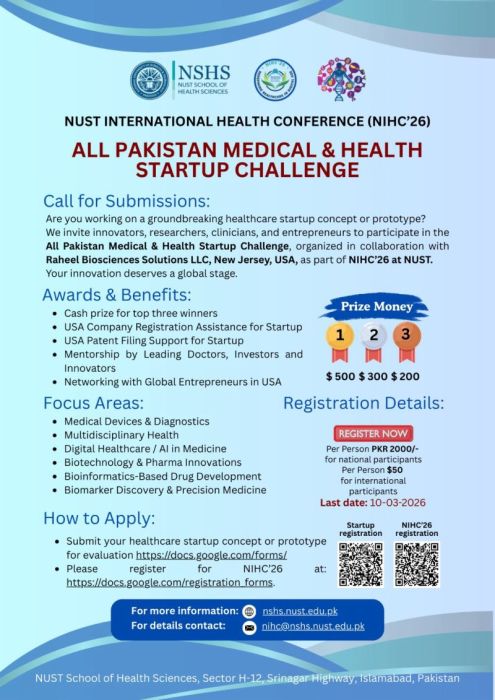
12/2026
A significant and impactful transformation is occurring in Pakistan’s healthcare sector, one that could redefine how the country identifies, develops, and provides medical solutions. At the NUST International Health Conference (NIHC’26), the launch of the All Pakistan Medical & Health Startup Challenge is more than just an event; it’s a strategic turning point in connecting biomedical research, digital health innovation, and entrepreneurial efforts. Led by the NUST School of Health Sciences and in partnership with Raheel Biosciences Solutions LLC, New Jersey, USA, this initiative positions Pakistan at the forefront of the rapidly evolving global discussion on medical technology, biotechnology, and AI-driven healthcare systems. More than simply a competition, it acts as a vital translational bridge, turning academic knowledge and clinical expertise into scalable, real-world health solutions with both national and international impact.
Catalyzing Healthcare Innovation in Pakistan
Healthcare systems worldwide are being transformed by digital innovation, artificial intelligence, precision medicine, and biotechnology-based therapeutics. Pakistan, with its growing community of clinicians, biomedical researchers, and data scientists, is at a crucial crossroads. The All Pakistan Medical & Health Startup Challenge aims to leverage this intellectual capital by inviting innovators, researchers, clinicians, and entrepreneurs to submit innovative healthcare startup ideas or working prototypes.
The initiative focuses on high-impact domains critical to both national and global health systems:
- Medical Devices & Diagnostics
- Digital Healthcare and Artificial Intelligence in Medicine
- Biotechnology & Pharmaceutical Innovations
- Bioinformatics-Driven Drug Development
- Biomarker Discovery and Precision Medicine
- Multidisciplinary Health Solutions
These focus areas align with emerging global priorities like AI-assisted diagnostics, predictive analytics in public health, personalized treatment approaches, and scalable, low-cost medical devices.
From Research to Real-World Impact
Historically, scientific conferences have focused on peer-reviewed publications and theoretical discussions. NIHC’26 broadens this approach by integrating entrepreneurship into a biomedical conference setting. This shift reflects a global change in academic medicine, highlighting translational research, innovation, commercialization, and measurable social impact.
The challenge provides tangible incentives designed to move ideas from concept to company:
- Cash prizes for top winners
- Support for registering a U.S. company
- Support for U.S. patent applications
- Mentorship from top physicians, investors, and global entrepreneurs
- International networking prospects
While monetary awards encourage, intellectual property support, and global exposure are more likely to generate lasting momentum for early-stage startups. In biomedical innovation, structured mentorship and regulatory guidance often determine whether a promising idea develops into a scalable healthcare solution.
Digital Health and AI in Medicine: A Strategic Focus
One of the most compelling aspects of the challenge is its focus on digital healthcare and AI in medicine. Worldwide, artificial intelligence is being used to improve diagnostic imaging, forecast disease progression, streamline hospital workflows, and tailor treatment plans.
In low- and middle-income countries, including Pakistan, AI-driven healthcare solutions have the potential to:
- Expand diagnostic access in underserved regions
- Reduce healthcare delivery costs
- Enhance clinical decision support systems
- Improve disease surveillance and public health planning
By encouraging local innovators to develop AI-powered medical tools and digital health platforms, the startup challenge aligns national priorities with global technological trends.
Biotechnology and Precision Medicine: Building Research Ecosystems
Equally important is the focus on biotechnology innovation, pharmaceutical advancements, and biomarker discovery. Precision medicine, which customizes treatment based on genetic, molecular, and clinical profiles, is transforming patient care in oncology, infectious diseases, and chronic conditions.
Pakistan’s expanding expertise in molecular biology, virology, bioinformatics, and translational medicine provides a solid base for creating solutions tailored to local needs. By integrating bioinformatics-driven drug development and biomarker research into the startup framework, NIHC’26 underscores the significance of interdisciplinary collaboration among clinicians, laboratory scientists, and computational experts.
Such ecosystems are vital for enhancing national research capacity and attracting international collaborations.
Academic Leadership in Health Entrepreneurship
University-led startup challenges act as hubs of innovation. By positioning this initiative within an international health conference, NUST underscores the growing role of higher education institutions not only as centers of knowledge creation but also as drivers of economic and technological progress.
This approach aligns with global best practices, where academic institutions actively support biomedical startups through structured mentorship, intellectual property assistance, and industry engagement. The All Pakistan Medical & Health Startup Challenge shares a similar goal: to develop a sustainable healthcare innovation ecosystem within Pakistan.
A Global Outlook with Local Relevance
Partnering with U.S.-based organizations, this initiative offers you pathways to global markets, making your solutions relevant both locally and internationally and addressing health issues beyond borders.
By offering pathways for U.S. company registration and patent filing support, the challenge allows Pakistani innovators to reach global markets while meeting local healthcare needs. This dual focus on local relevance combined with global scalability characterizes modern biomedical entrepreneurship.
Registration and Participation
The competition welcomes participants nationwide and internationally, with a March 10, 2026, submission deadline that provides a clear timeline for refining prototypes and preparing impactful applications.
For researchers, clinicians, and students working at the intersection of medicine and technology, the challenge offers a platform to showcase solutions and connect with investors, academics, and healthcare leaders, fostering growth and collaboration.
Conclusion: Advancing Pakistan’s Health Innovation Ecosystem
The All Pakistan Medical & Health Startup Challenge 2026 marks a key step in Pakistan’s path toward leadership in digital health, biomedical entrepreneurship, and precision medicine innovation. By combining scientific rigor, entrepreneurial vision, and global collaboration, the initiative fosters a culture in which research translates into practical solutions.
In a time marked by rapid technological advances and complex global health challenges, platforms that support local innovators are essential. Through NIHC’26, Pakistan demonstrates its readiness to make meaningful contributions to the global biomedical innovation scene — not just as a participant, but as a source of transformative ideas.
According to the Editor-in-Chief of Biomedglobal, Prof. Dr. Muhammad Mukhtar, such initiatives highlight a forward-looking vision: a healthcare system powered by science, propelled by innovation, and supported by collaborative leadership.