Emotional Blindness: When You Feel Something but Cannot Name It
Posted 1 month ago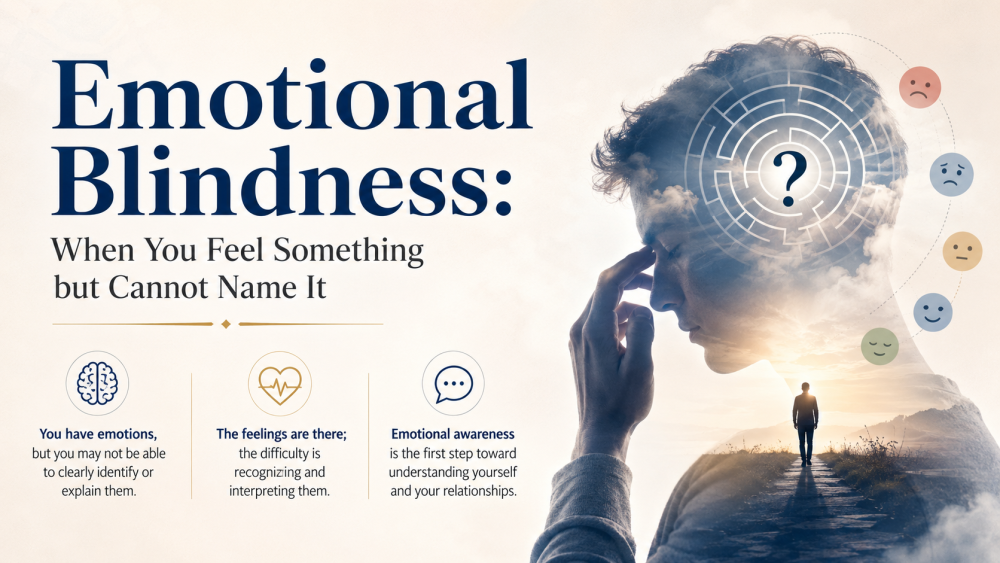
56/2026
Emotional blindness is the difficulty of recognizing, understanding, and expressing what you are feeling.
In everyday language, it means:
You have emotions, but you may not be able to identify or explain them clearly.
For example, you might feel your heart racing, become irritated, withdraw from others, or feel unusually tired, but when someone asks, “What’s wrong?”, you genuinely cannot tell whether you are anxious, sad, angry, disappointed, or overwhelmed.
It is not the same as being emotionless. The feelings are there; the difficulty is recognizing and interpreting them.
The scientific term most closely associated with emotional blindness is alexithymia, which refers specifically to difficulty identifying and describing one's own emotions. It is not the same as having no emotions. Rather, a person may experience emotions but have difficulty recognizing and putting them into words. Scientific reviews describe alexithymia as a multidimensional difficulty involving emotional awareness, identification, and communication.
Feeling an Emotion Without Understanding It
Emotions are not simply thoughts. They involve complex interactions among the brain, body, memories, attention, and the environment. When something frightening happens, for example, the heart may beat faster, muscles may tense, and breathing may change. The brain then interprets these bodily signals in the context of the situation.
This connection between bodily sensations and emotional awareness is known as interoception, our ability to perceive and interpret signals from within the body.
Research suggests that interoception can contribute to our ability to recognize emotions. A meta-analysis of 66 independent samples and more than 7,000 participants found a small overall negative association between alexithymia and interoceptive awareness. However, the relationship varied considerably depending on how interoception was measured.
This may help explain why emotional blindness can sometimes feel confusing. A person may experience a fast heartbeat, a tight chest, stomach discomfort, or exhaustion but fail to connect these sensations with anxiety, anger, sadness, or fear.
The Language of Emotion
One of the most important aspects of emotional awareness is having an emotional vocabulary.
Imagine someone returning home after a difficult day. Their partner asks, “What's wrong?” They respond, “Nothing.” But internally, they feel tense, disappointed, and emotionally exhausted. They may not be deliberately hiding their feelings. They may genuinely be unable to identify them.
Research on alexithymia commonly identifies two central difficulties: difficulty identifying feelings and difficulty describing them. A third characteristic is an externally oriented thinking style, in which attention tends to focus more on concrete events and external circumstances than on one's internal emotional experience. This distinction is important. Someone might be perfectly capable of saying, “My manager criticized my work today,” while struggling to say, “I felt embarrassed and disappointed when my manager criticized my work.”
The first statement describes an event. The second describes an emotional experience.
Is Emotional Blindness a Mental Illness?
Not necessarily.
Alexithymia is generally regarded as a personality or psychological construct rather than a standalone psychiatric diagnosis. It can occur to varying degrees, and people can experience these difficulties without a mental disorder. At the same time, elevated alexithymia has been observed in association with a range of psychiatric and neurological conditions.
This is why the term “emotional blindness” should be used carefully. Difficulty identifying emotions does not automatically indicate a psychological disorder. It can also be influenced by personality, development, social learning, and the way people have learned to think about emotions.
Why Does It Matter?
Understanding one's emotions is more than an exercise in self-awareness. Emotions convey information. Anger can signal that we perceive unfairness or that a boundary has been crossed. Fear can alert us to potential danger. Sadness may indicate loss or the need for support. Anxiety can signal uncertainty or a perceived threat. Happiness can tell us that an experience is meaningful or rewarding.
When people cannot identify these signals, they may find it harder to understand why they behave in particular ways.
For example, a person who cannot recognize mounting frustration might continue working until they suddenly become irritable with colleagues. Someone who cannot identify anxiety may interpret physical tension as mere tiredness. Another person may repeatedly withdraw from social situations without recognizing that they are experiencing fear or insecurity. Research has also linked alexithymia to difficulties in processing emotional information. Reviews have found associations with differences in attention, appraisal, memory, and emotion-related language.
Emotional Blindness Can Affect Relationships
Emotional communication is fundamental to relationships.
Consider the difference between saying:
“Leave me alone.”
and
“I'm overwhelmed right now and need some time to calm down.”
The first statement communicates behavior. The second communicates the emotional state underlying the behavior.
When people struggle to identify their emotions, their partners, friends, or colleagues may have difficulty understanding them. As a result, emotional misunderstandings can become more frequent.
Research has also found an association between alexithymia and difficulties in recognizing emotional facial expressions. A systematic review and meta-analysis of 24 studies found a significant negative relationship between alexithymia and overall facial-expression recognition, particularly for static facial expressions.
Thus, emotional awareness involves both looking inward and interpreting emotional signals in others.
Can Emotional Awareness Be Improved?
The encouraging answer is that emotional awareness is not necessarily fixed. The first step is to slow down and become curious about internal experience. Instead of asking only, “What happened?” try asking:
What am I feeling right now?
Then ask:
- Where do I feel in my body?
- Is my heart beating faster?
- Are my muscles tense?
- Am I angry, afraid, disappointed, embarrassed, or sad?
- What happened immediately before this feeling?
- What do I need right now?
It helps to expand your emotional vocabulary. Instead of describing everything as “good,” “bad,” “stressed,” or “fine,” try using more precise words: frustrated, lonely, disappointed, relieved, anxious, ashamed, hopeful, resentful, grateful, or overwhelmed. Writing down emotions can also help you connect situations, bodily sensations, thoughts, and behavior.
Importantly, people who persistently struggle to understand their emotions may benefit from speaking with a qualified mental health professional. Emerging research is investigating interventions specifically aimed at reducing alexithymia, although the evidence base and effective approaches are still developing.
The Blind Spot We Can Learn to See
Perhaps the most important lesson about emotional blindness is that not being able to name an emotion does not mean that the emotion is not there.
Sometimes the body notices before the conscious mind does. A clenched jaw, restless sleep, a heavy chest, a racing heart, or sudden irritation may be signals from an emotional system that has not yet been translated into words.
Emotional awareness is, in many ways, the process of learning that language.
The goal is not to analyze every feeling or to turn life into a continuous psychological examination. It is simply to develop enough awareness to recognize what is happening within us and then decide how to act on that information.
After all, emotions influence our relationships, decisions, priorities, and behavior, whether we consciously understand them. Learning to name what we feel can therefore be one of the first steps toward understanding why we think, act, and relate to others as we do.
According to Professor Emeritus Dr. Muhammad Mukhtar, Rector of the University of Southern Punjab, Multan, Pakistan, I have seen hundreds of people struggle with emotional blindness, often without realizing what they are experiencing. Their inability to recognize, understand, or express their emotions can make their own lives difficult and, at times, cause discomfort and misunderstanding for those around them.
At the University of Southern Punjab, we believe emotional well-being is essential to a healthy, productive life. To support our community, the University has established a Wellness Center where students and employees can seek guidance and support, and find a safe space to discuss emotional and personal challenges.
We encourage anyone facing such difficulties not to suffer in silence. Recognizing our feelings is the first step toward understanding ourselves, improving our relationships, and living a healthier life.
Commenting on the article above, Dr. Ruqia Safdar Bajwa, Assistant Professor at Bahauddin Zakariya University, Multan, on USP's efforts says, "A great initiative. Wellbeing of employees and students should be a top priority of any organization."