Why Do We Faint? The Hidden Science Behind a Sudden Faint (Syncope)
Posted 2 months ago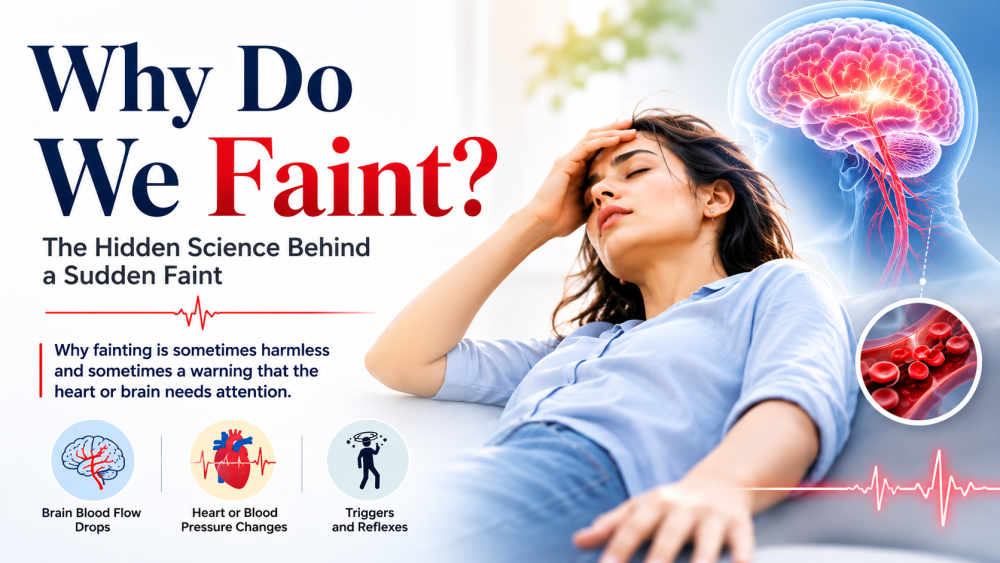
49/2026
Why fainting is sometimes harmless and sometimes a warning that the heart or brain needs attention
One moment you are standing, talking, walking, or perhaps waiting in a crowded room. The next, everything disappears.
You wake up on the floor.
For many people, fainting is a frightening yet brief event. In medicine, it is called syncope, a sudden, temporary loss of consciousness caused by a brief reduction in blood flow to the brain, followed by spontaneous recovery. It is common, but it should never be dismissed as "just fainting." Syncope is not a disease. It is a symptom, and its causes range from relatively harmless reflexes to potentially dangerous heart problems.
The challenge for doctors is therefore not merely to explain why someone fainted, but to determine which type of fainting occurred and whether something serious is hidden beneath it.
What happens when we faint?
The brain is highly dependent on a continuous supply of blood carrying oxygen and glucose. When cerebral blood flow drops abruptly, consciousness can be lost.
A delicate interaction among the heart, blood vessels, and nervous system determines blood pressure. If the heart suddenly pumps less blood, the blood vessels fail to maintain adequate pressure, or blood pools in the legs after standing, blood flow to the brain may briefly decrease.
The result can be remarkably rapid:
light-headedness → visual dimming → loss of consciousness → collapse → recovery.
In true syncope, recovery is usually spontaneous and relatively quick. That distinguishes syncope from several other causes of apparent "blackouts," including seizures and some metabolic or neurological disorders.
Three broad pathways to fainting
Although the mechanisms can be complicated, most cases can be understood through three broad categories.
1. Reflex or vasovagal syncope: the body's overreaction
This is perhaps the type most people recognize.
A person may faint after:
- seeing blood,
- experiencing severe emotional distress,
- suffering pain,
- standing for a long time,
- being in a hot or crowded environment,
- becoming dehydrated, or
- undergoing an unpleasant medical procedure.
The body's autonomic nervous system can suddenly slow the heart rate and/or dilate blood vessels. Blood pressure falls, blood flow to the brain decreases, and consciousness may briefly be lost.
Often there is a warning.
A person may feel:
warm, sweaty, nauseated, weak, dizzy, or as though their vision is narrowing.
These warning symptoms are important because they can provide precious seconds to sit or lie down before falling.
2. Orthostatic hypotension: when standing makes the pressure drop
Have you ever stood up quickly and felt dizzy? That sensation is common because gravity suddenly pulls blood toward the legs. Normally, the nervous system rapidly constricts blood vessels and adjusts the heart rate to maintain blood pressure.
Sometimes that compensation is inadequate.
Blood pressure falls after standing, causing dizziness or, in some people, syncope. Dehydration, blood loss, prolonged bed rest, and certain medications, including some drugs used to treat high blood pressure, can contribute.
This is particularly important in older adults, in whom multiple medications, reduced physiological reserve, and other medical conditions can interact.
3. Cardiac syncope: when the heart is the culprit
This category deserves particular attention.
The heart may fail to maintain adequate blood flow because of an abnormal rhythm, structural heart disease, or another cardiovascular condition. An electrical disturbance can cause the heartbeat to be too slow, too fast, or dangerously irregular. Unlike vasovagal fainting, cardiac syncope may occur suddenly and with little warning.
Fainting during exercise, fainting while lying down, a history of heart disease, an abnormal electrocardiogram, or a family history of sudden unexplained death can raise concern. This is one reason physicians take the circumstances surrounding a fainting episode so seriously.
The most important diagnostic tool may be a conversation
It is tempting to think that diagnosing syncope requires a battery of sophisticated tests.
Often, the first and most valuable diagnostic instrument is much simpler:
A careful history.
What was the person doing immediately before the episode?
Were they standing, sitting, or lying down?
Was there pain, fear, heat, or prolonged standing?
Did they feel nausea or sweating?
Did the heart race or pound?
Did the person experience chest pain?
Was there any warning at all?
How long were they unconscious?
What did witnesses observe?
Was there confusion afterward?
Did the event happen during exercise?
Was there an injury from the fall?
These seemingly small details can dramatically change the diagnostic picture.
Why the ECG matters
An electrocardiogram, usually called an ECG or EKG, records the heart's electrical activity. It is quick, non-invasive, and relatively inexpensive. For someone who has fainted, an ECG can reveal clues that suggest an abnormal heart rhythm or an electrical disorder that could explain the episode. This does not mean every person who faints has heart disease. Quite the opposite: many episodes have benign explanations. But the possibility of a cardiac cause is important enough that the ECG is part of the standard initial assessment.
Not everyone needs a CT scan or dozens of blood tests
When history, examination, and ECG do not suggest a neurological problem, routine brain imaging or an EEG is generally not recommended solely because of fainting. Similarly, broad laboratory testing without a clinical indication often contributes little. Instead, testing should be guided by what the history and examination suggest.
The best test is often the test that answers a specific question.
Syncope is not the same as a seizure.
The two can sometimes look remarkably similar. Both can involve loss of consciousness and falling, and some people with syncope may experience brief, involuntary movements. That is why witnesses can be extremely helpful. A detailed account of what happened before, during, and after the episode can help physicians distinguish syncope from epilepsy and other conditions. For example, a prolonged period of confusion after the event may point the investigation in a different direction.
When fainting becomes a warning sign
Not every fainting episode requires hospitalization, but some circumstances deserve urgent medical evaluation.
Concern arises when syncope occurs:
- during physical exertion;
- while lying down;
- without any warning;
- with chest pain or severe shortness of breath;
- with sustained palpitations;
- in someone with known heart disease;
- in someone with an abnormal ECG;
- after a significant injury;
- repeatedly over a short period; or
- in a person with a family history of unexplained sudden death.
These features do not automatically indicate that a dangerous condition is present. They mean that the possibility warrants careful assessment.
What should you do if you feel yourself fainting?
The body's warning symptoms can be lifesaving.
If you suddenly feel light-headed, weak, sweaty, nauseated, or as though your vision is fading:
Sit down or, preferably, lie down immediately.
Do not try to "fight through" the sensation while standing.
If possible, elevate your legs while lying down. This can help improve blood return to the heart and brain.
If you are with someone who has fainted, make sure they are in a safe position and check that they are breathing normally. A person who does not quickly regain consciousness, has difficulty breathing, has chest pain, has sustained a significant injury, or otherwise appears seriously ill needs urgent medical attention.
Treatment depends on the cause.
There is no single medicine called the "fainting treatment."
The treatment follows the cause.
For reflex syncope, physicians may recommend better hydration, recognizing triggers, avoiding prolonged standing, and, when appropriate, learning physical counter-pressure maneuvers.
For orthostatic hypotension, treatment may include reviewing medications, correcting dehydration or other contributing factors, and addressing the underlying disorder.
For cardiac syncope, treatment may vary considerably. Depending on the underlying issue, treatment may include medication, management of an abnormal rhythm, catheter-based procedures, a pacemaker, or other specialized cardiac therapy.
The European Society of Cardiology's guideline framework similarly separates treatment according to the underlying mechanism, including reflex syncope, orthostatic hypotension and cardiac causes.
Why older adults require special attention
Fainting can become more complicated with age.
An older person may simultaneously be taking several medications, have cardiovascular disease, have impaired blood-pressure regulation, and be more vulnerable to injury from a fall. The fainting episode itself may therefore be only part of the problem. A fall can lead to fractures, head injuries, or loss of independence.
The ACC/AHA/HRS guideline notes that assessing older adults can benefit from a comprehensive approach that considers geriatric factors.
The mystery is often in the moments before a fall.
Perhaps the most revealing part of a fainting episode is not the moment when consciousness is lost. It is the few seconds before it happens.
A person who says:
"I was standing in a hot room, became nauseated and sweaty, my vision narrowed, and then I collapsed"
is telling a very different medical story from someone who says:
"I was running, suddenly lost consciousness without warning, and woke up on the ground."
Both are "fainting."
A faint should not always be frightening, but it should be respected
Syncope reminds us of a fundamental truth about the human body: consciousness depends on a remarkably precise physiological balance. If that balance is disrupted, the brain can switch off for a few seconds.
Disclaimer:
The contents provided on www.biomedglobal.org are intended for general informational and educational purposes only. This website's information, articles, and resources are based on data and findings from scientific publications, publicly available research, and reputable sources.
While every effort is made to ensure accuracy and reliability, Biomed Global does not guarantee, endorse, or assume responsibility for the completeness, timeliness, or validity of the information.
The material on this website should not be considered a substitute for professional advice, diagnosis, or treatment. Users are strongly encouraged to consult qualified healthcare professionals, researchers, or subject-matter experts before making decisions based on the information presented here.
Under no circumstances shall Biomed Global, its affiliates, contributors, or authors be held liable for any direct, indirect, incidental, or consequential damages arising from the use of, or reliance on, the content of this website.
By accessing and using www.biomedglobal.org, you fully acknowledge and agree to this disclaimer.