Your Toilet May Soon Become Your Most Intimate Health Monitor
Posted 1 month ago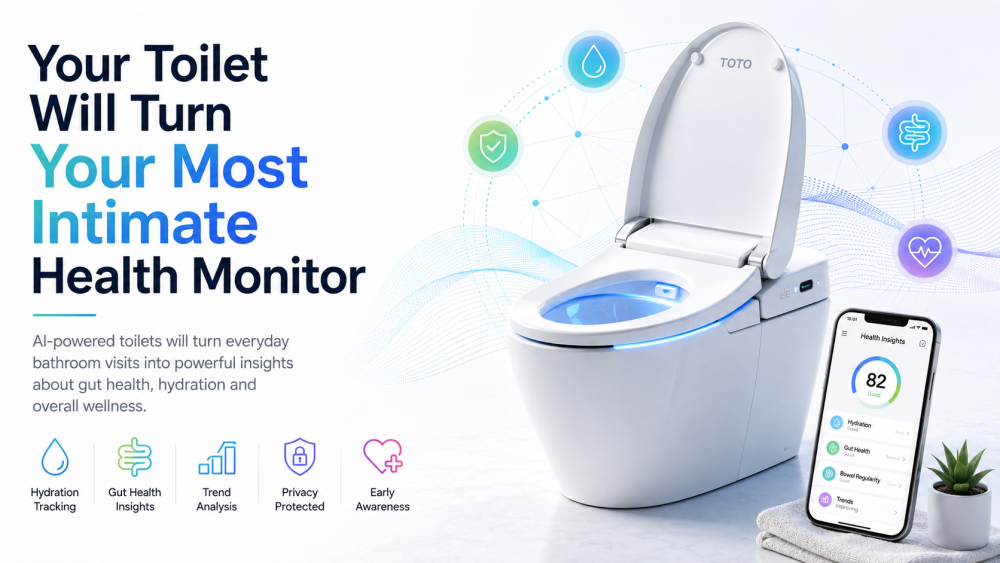
48/2026
According to a Business Insider report, a new generation of smart toilets and toilet-mounted sensors is beginning to use cameras, optical sensors, computer vision, and AI to analyze stool and urine. Companies including TOTO, Throne, Kohler, and Vivoo are developing systems that can track characteristics such as stool consistency, color, and volume, as well as urinary patterns and hydration.
It sounds futuristic and perhaps slightly uncomfortable. But beneath the novelty lies a potentially important transformation in medicine: passive health monitoring that happens without asking people to remember, measure, or even think about it.
The bathroom becomes a laboratory.
Imagine using your toilet as usual. You flush and leave, and the system quietly records what happened via a camera that clips onto the toilet, using AI-based computer vision to analyze stool consistency and urine color. The information can then be displayed as a long-term record, allowing users to see patterns rather than isolated events. TOTO has developed toilets in Japan with sensors that assess stool characteristics, while Kohler's Dekoda and other devices explore optical analysis of stool and urine. Vivoo's technology focuses particularly on urine and hydration.
The important word here is trend.
A single unusual bowel movement usually tells us very little, but a persistent change from someone's normal pattern could be more informative. That is why these systems attempt to establish an individual's baseline, a picture of what is normal for that person, and then detect meaningful deviations.
Why Doctors Are Interested
Gastroenterologists already know how valuable a detailed bowel diary can be. Unfortunately, patients often cannot provide an accurate one. A person may remember being constipated “for a while” but not whether it happened three or ten times. Someone with irritable bowel syndrome may struggle to link symptoms to food, stress or medication. An automated record could provide a closer approximation of an objective timeline.
AI and the extraordinary complexity of the gut
The human digestive system is not a simple machine. Bowel habits can be influenced by diet, water intake, sleep, stress, medications, hormones, physical activity, infections, travel, and many other factors. The vast community of microorganisms inhabiting our intestines—the gut microbiome—is an active area of research, and scientists are still learning how to translate microbiome measurements into reliable individual medical advice.
That creates a fundamental challenge for AI.
More data does not automatically mean more knowledge.
An algorithm may discover that a person's bowel movements change after stressful days. But correlation does not necessarily establish causation. Perhaps stress is responsible. Perhaps sleep has changed at the same time. Perhaps the person ate differently.
From smart homes to sensing homes
For decades, technology has been making homes smarter. Thermostats learn our habits. Cameras recognize faces. Watches monitor our bodies. The next step may be homes that quietly monitor biology itself. The bathroom could become one of the most important nodes in that network.
A future home might combine data from a toilet, a smartwatch, a sleep tracker, a blood pressure monitor, and other sensors. AI could then identify relationships among thousands of observations that would be impossible for a person to recognize.
Who owns the data?
A toilet that knows when you use it, what your stool looks like, and how your urinary patterns change is collecting highly personal information. Health data can reveal far more than people realize. If bathroom data becomes part of commercial health platforms, questions about consent, cybersecurity, data ownership, insurance, and medical privacy will grow increasingly important. The smarter the toilet becomes, the more carefully society will need to decide who gets to see what it knows.
A toilet that notices what we don't.
Every day, our bodies produce information. Much of it disappears with a flush. Artificial intelligence is beginning to ask whether some of that information should be captured not to replace doctors, but to give them a continuous window into the biology of everyday life. The bathroom, once regarded as the least glamorous room in the house, may be evolving into something entirely different:
a laboratory that never closes, a health diary that never forgets, and perhaps one day, an early-warning system sitting beneath us every morning.
The scientific challenge now is not simply to make toilets smarter.