When Artificial Intelligence Starts Writing the Doctor’s Notes: Progress or a Threat to Medical Learning?
Posted 12 hours ago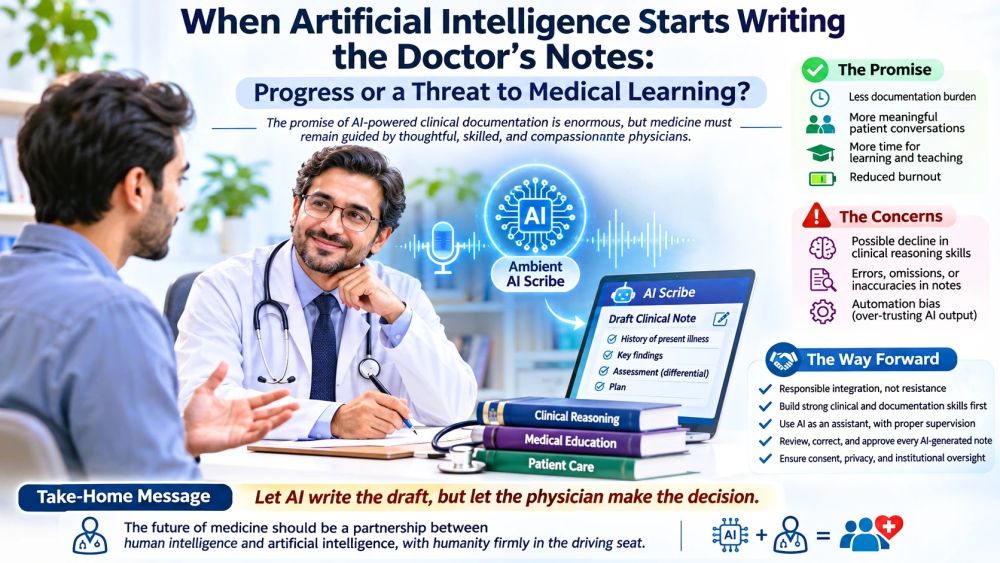
72/2026
The promise of AI-powered clinical documentation is enormous, but medicine must remain guided by thoughtful, skilled, and compassionate physicians.
Imagine visiting your family doctor and discovering that, while you describe your symptoms, an artificial intelligence (AI) system is quietly listening, recording the conversation, and preparing your medical notes. By the time your consultation ends, much of the documentation is already complete. Your doctor can spend less time looking at a computer screen and more time listening to you.
This is no longer science fiction. It is happening in healthcare systems worldwide through a technology known as the ambient AI scribe.
A New England Journal of Medicine (NEJM) Clinical Decisions article, titled Use of an Artificial Intelligence Scribe for Clinical Notes and published on November 5, 2026, brings an important question into focus: Should medical residency programs allow young doctors to use AI scribes, or could this convenience undermine the very skills they need to become competent physicians?
This debate deserves attention beyond medical schools because it affects how future doctors are trained and how safely they practice.
Doctors face an extraordinary administrative burden. After examining patients, they must document medical histories, symptoms, diagnoses, investigations, and treatment plans. Much of this work happens after clinic hours, leaving less time for reading, research, teaching, family, and rest.
AI scribes offer a potentially valuable solution. They listen to conversations, generate draft clinical notes, and help organize information for the physician to review.
A research article published in JAMA Network Open in 2025 has reported improvements in clinicians' documentation experience and reductions in administrative burden. A 2025 pilot study involving 47 medical residents also reported reduced documentation time and fewer after-hours documentation demands.
The potential benefit is considerable: less typing could mean more meaningful patient conversations, better attention to concerns, and more time for education.
Ultimately, patients should feel that their doctor is listening, not merely entering information into a computer.
The NEJM article raises an equally important concern. Medical documentation is not merely administrative. Writing a clinical note requires a doctor to interpret symptoms, distinguish important information from irrelevant details, consider possible diagnoses, and develop an appropriate treatment strategy.
These activities train the clinical mind and becomes the base of empirical data and cognitive power of an experienced doctor.
If a young physician routinely relies on AI to prepare medical notes, will that physician gradually lose the ability to think independently, recognize subtle symptoms, and communicate clinical uncertainty?
There are also genuine accuracy concerns. AI-generated notes may omit important information, misattribute statements, or introduce details that were never discussed. A 2025 study published in BMJ Digital Health & AI highlighted such problems in AI-assisted primary-care documentation.
Consider a patient reporting chest pain. An AI system might produce a polished note describing the discomfort but fail to capture whether the physician explored potentially dangerous symptoms such as breathlessness, sweating, or pain radiating to the arm.
A beautifully written medical record is of little value if it contains clinically important errors.
This raises another concern: automation bias, the tendency to trust computer-generated information simply because it appears authoritative, which can further distort judgment.
The answer, then, is responsible integration, not resistance.
According to Prof. Emeritus Dr. Muhammad Mukhtar, Rector of the University of Southern Punjab, Multan, Pakistan and Editor-in-Chief of Biomedglobal neither unconditional adoption nor outright rejection of AI scribes is right. Instead, medical education must evolve with technological progress, but it must never surrender the foundations of clinical practice.
The solution is responsible integration.
Medical students and residents should first develop fundamental skills in patient interviewing, clinical reasoning, diagnostic interpretation, and medical documentation. AI should then be introduced as an assistant, with appropriate supervision and systematic evaluation.
A qualified physician must review, correct, and approve every AI-generated clinical note. Patient consent, confidentiality, data protection, and institutional accountability must be non-negotiable.
Medical institutions should also assess whether AI-assisted documentation improves learning outcomes, reduces burnout, and preserves diagnostic competence. Residents should continue to write clinical notes independently, so their skills do not deteriorate.
For developing and underdeveloped nations, this discussion is particularly significant because their healthcare institutions face shortages of medical professionals, heavy patient loads, and rising administrative demands. Well-implemented AI technologies could improve efficiency and make healthcare professionals more productive.
However, adopting expensive technologies without adequate infrastructure, training, data protection, and institutional oversight could create new inequalities and risks.
Medical universities, teaching hospitals, and regulatory bodies should therefore develop clear policies for the ethical and educational use of AI in clinical practice.
We must prepare our young doctors not merely to use AI, but to question it, evaluate its output, and recognize its limitations.
Take home message is: The physician of tomorrow must remain human.
Artificial intelligence will undoubtedly transform medicine. It can help doctors organize information, reduce repetitive tasks, and make healthcare more efficient. Even so, empathy, judgment, ethical responsibility, and the ability to understand human suffering cannot be delegated to an algorithm.
The most successful physician of the future will not necessarily be the one who uses the most sophisticated AI system, but the one who knows when to use it, when to challenge it, and when to rely on human judgment.
The principle is simple: Let AI write the draft but let the physician make the decision.
Technology should give doctors more time to be doctors. In turn, it should strengthen medical education, not weaken it; improve patient care.
The future of medicine should be a partnership between human intelligence and artificial intelligence, with humanity firmly in the driving seat.