Theranos Returns: A New Film Rekindles the Scars of Scientific Deception
Posted 21 hours ago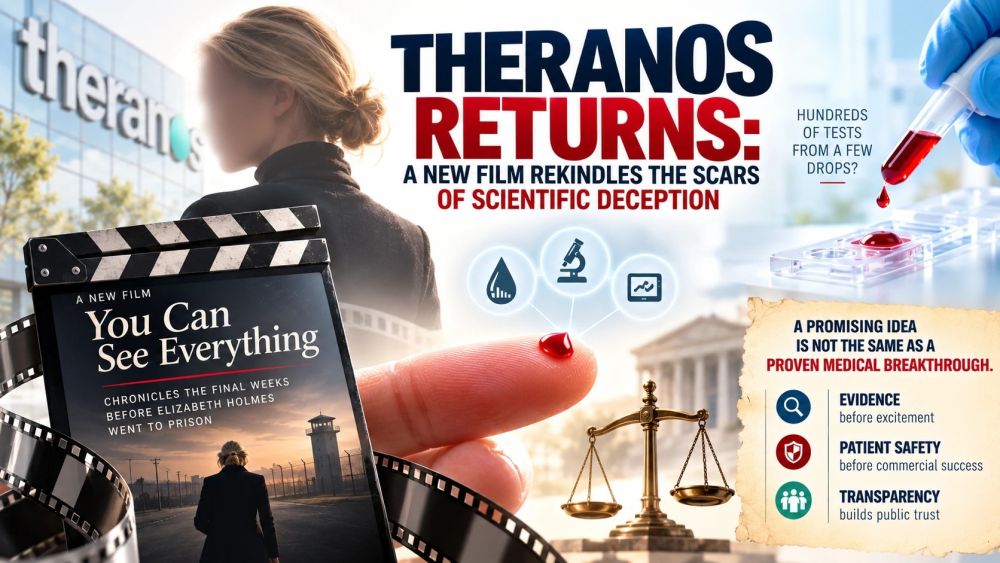
67/2026
The story of Elizabeth Holmes, the founder of the failed biotechnology company Theranos, is back in the news following the release of a new film, You Can See Everything. The film looks at the final weeks before Holmes went to prison in 2023.
Her story is not just about a business failure. It also warns of the dangers of making big promises without strong scientific evidence.
Elizabeth Holmes, once celebrated as a visionary entrepreneur who promised to revolutionize medical testing, became one of the most controversial figures in biotechnology history. Her company, Theranos, claimed it could perform hundreds of medical tests using just a few drops of blood from a fingertip. The promise attracted wealthy investors, captured public attention, and raised hopes for a new era of affordable healthcare. But the technology failed to deliver. Holmes was convicted of defrauding investors and was originally sentenced to 11 years and three months in federal prison. In March 2026, the court reduced her sentence to 10 years and three months. The court also ordered her and her former business partner to pay about $452 million in restitution to victims. Her story powerfully reminds us that medical science must back ambition and innovation with reliable evidence, transparency, and accountability. When scientific claims are exaggerated or misleading, the consequences can extend far beyond a failed business, undermining public trust in the very technologies designed to improve human health.
A Revolutionary Idea That Failed
During the 2010s, Holmes promised to revolutionize medical testing. Her company claimed its technology could run hundreds of blood tests from just a few drops of fingertip blood. The idea was compelling. Today, many medical tests require drawing blood from a vein in the arm and sending it to a laboratory. Doctors use these tests to check blood sugar, hormones, infections, and other signs of health problems.
Theranos promised to make testing easier, faster, and less uncomfortable. Investors believed in the idea and provided substantial funding.
However, the technology did not work as promised. Investigations revealed that Theranos often used standard testing machines from other companies instead of its own technology. In some cases, the company diluted blood samples, which could affect the accuracy of test results.
Holmes was found guilty of defrauding investors and was sentenced to prison. The scandal damaged confidence in companies promising revolutionary medical breakthroughs.
Why Are a Few Drops of Blood Difficult to Test?
Accurately testing a tiny blood sample is harder than it may seem. When you collect blood from a fingertip, squeezing the finger too hard can damage blood cells and skew the results. The small sample may also contain too little of certain substances for a machine to detect them reliably. For example, blood usually contains enough sugar for a test to measure. But some signs of infection or disease may be present in extremely small amounts. Detecting them requires highly sensitive equipment and carefully designed tests. That is why scientists must prove a new testing device produces accurate, dependable results before doctors can safely use it.
Scientists Have Not Given Up
Despite the Theranos scandal, researchers keep developing simpler ways to test blood.
Babson Diagnostics, for example, offers a service called BetterWay that uses a special device to collect six to twelve drops of blood from a fingertip. The device is designed to make blood collection more reliable and reduce damage to blood cells.
Another company, Truvian Health, is developing a machine called TruVerus. The company says it can measure 40 different substances in a blood sample and deliver results in under 25 minutes. This has received 510(k) clearance (K251058) for TruVerus™, the industry’s first multimodal blood testing benchtop instrument.
These developments show that faster blood testing is possible, but each new device must be carefully tested.
Testing at Home
Other researchers want to make medical testing so simple that people can use inexpensive devices at home. One promising idea uses specially designed paper strips. A drop of blood or another body fluid moves through the paper and reacts with chemicals that help reveal substances. Such tests could be cheaper and easier to use than large laboratory machines.
This approach could be especially valuable for people living in remote areas, where hospitals and laboratories may be far away. However, developing a useful device is only part of the challenge. Companies must also demonstrate that their tests are reliable and provide real benefits to patients.
New Technology, Old Lessons
Another company, Haemanthus, associated with Holmes’s fiancé, Billy Evans, is developing technology to detect thousands of substances in blood, urine, and saliva.
The proposed system uses laser light to study the chemicals present in a sample. Although this scientific technique is already known, its ability to deliver reliable results for medical diagnosis still needs to be demonstrated.
The central question is simple: can the device accurately identify what it claims to measure?
Science Must Come Before Promises
The Theranos scandal has not stopped scientists from seeking better medical tests. Instead, it has taught the entire healthcare industry an important lesson.
A promising idea is not the same as a proven medical breakthrough.
Faster, cheaper blood tests could help doctors diagnose diseases earlier and make healthcare more accessible, especially for people living far from medical facilities. But new devices must be properly tested, their results independently verified, and their limitations openly acknowledged.
The future may bring medical tests that require only a few drops of blood and provide results within minutes. To earn public trust, however, these innovations must deliver on their promises.
Theranos reminds us that in medical science, evidence must always come before excitement, and patient safety before commercial success.