Children with Spinal Muscular Atrophy Can Walk Stronger with Wearable Robotic Assistance
Posted 4 months ago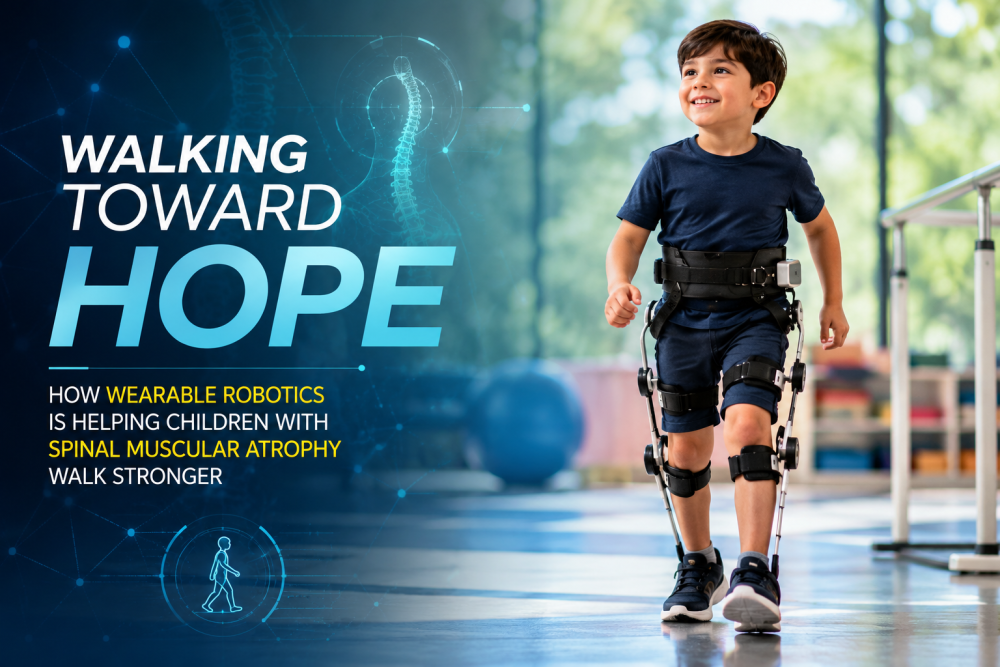
29/2026
Spinal Muscular Atrophy (SMA) is a rare inherited disease that affects the nerve cells in the spinal cord that control muscle movement. As these nerves gradually stop working properly, muscles weaken and shrink over time. The condition mainly affects muscles near the center of the body, such as the shoulders, hips, thighs, and back, making activities like sitting, walking, swallowing, and breathing difficult in severe cases.
SMA is usually caused by a defect in the SMN1 gene, which is essential for producing a protein needed for healthy motor neurons.
For years, children living with spinal muscular atrophy (SMA) have fought an invisible battle against their own muscles. Simple activities such as climbing stairs, standing from a chair, or walking across a playground can feel exhausting. Parents often describe the disease as watching strength slowly fade away.
Now, scientists have introduced something that sounds almost futuristic: a lightweight wearable robot designed to help children regain movement and muscle strength. And unlike the bulky robotic suits seen in science-fiction films, this device weighs less than a kilogram, lighter than many school bags.
The new technology, recently reported in the journal Nature, offers a glimpse of a future in which robotics and medicine work hand in hand to restore mobility and independence for children with rare neuromuscular disorders.
A Disease That Steals Strength
Children with SMA may struggle to sit, stand, walk, or, in severe cases, even breathe. In the past, many families had little hope because treatments were limited.
But the advent of gene therapies dramatically changed the landscape. Scientists developed treatments that target the disease's genetic root, enabling the body to produce a critical protein needed for healthy motor neurons. Many children who once faced rapid decline can now survive longer and enjoy improved movement.
Yet gene therapy is not a complete cure.
Even after treatment, many children continue to experience muscle weakness because muscles that have already weakened cannot rebuild themselves instantly. Rehabilitation remains a major challenge.
That is where the robotic wearable enters the story.
A Robot Designed for Children
The device looks more like sports equipment than a medical machine. Strapped around the legs and waist, it gently assists knee movement while children walk.
Instead of forcing movement, the wearable detects the child’s efforts and offers gentle, adaptable support at the right moment. This approach can foster confidence in caregivers and professionals, demonstrating a supportive step forward in rehabilitation.
Researchers tested the robotic system on children with SMA who had already received gene therapy. The results were encouraging.
Children using the device showed improved knee function, stronger walking ability, and better muscle performance. Importantly, the robot was lightweight enough to be worn comfortably during regular activity.
Scientists believe this combination of gene therapy plus robotic rehabilitation could represent a new era in treatment.
Why Timing Matters
One of the biggest lessons from modern medicine is that repairing genes is only part of the recovery process.
Gene therapy can help prevent further nerve damage, but weakened muscles often need training and support to regain strength.
This robotic system acts almost like a physical therapist that children can wear.
By encouraging repeated, assisted movement, the device may help muscles relearn movement patterns while reducing fatigue. Over time, this could help children build endurance and confidence.
For families, even small improvements can matter enormously. Walking farther without getting exhausted, climbing stairs more easily, or participating in school activities can transform everyday life.
Medicine Meets Engineering
The wearable robot is part of a broader revolution in healthcare.
Engineers and medical researchers are increasingly combining artificial intelligence, robotics, and neuroscience to develop devices that interface directly with the human body. Around the world, scientists are developing robotic limbs that move naturally, brain–computer interfaces that help paralyzed people communicate, and exoskeletons that support movement after injury.
What makes the SMA wearable particularly remarkable is its focus on children.
Designing medical robotics for adults is already challenging. Creating systems that are safe and comfortable for growing children requires even greater precision. Devices must be lightweight, adaptable, and easy to use in daily life.
The success of this wearable suggests that future pediatric rehabilitation may become more personalized and technology-driven.
Hope Beyond SMA
Researchers believe similar robotic systems could eventually assist people with conditions like muscular dystrophy, cerebral palsy, stroke recovery, and spinal injuries, expanding the potential impact of this technology.
The idea is simple yet powerful: instead of replacing human movement, technology can amplify the body’s remaining abilities.
This philosophy marks a shift in medicine.
For decades, treatments primarily focused on survival. Today, scientists increasingly aim to improve the quality of life, independence, and confidence.
That shift is especially important for children, whose emotional and social development depends heavily on mobility and participation.
A child who can walk more comfortably is not just gaining muscle strength. They may also gain freedom, confidence, friendships, and opportunities.
The Human Side of Technology
Perhaps the most moving aspect of the research is that the robot itself is not the true breakthrough.
The real breakthrough is what it represents.
For generations, rare diseases like SMA have often left families feeling powerless. Now, advances in genetics, robotics, and rehabilitation are beginning to change that narrative.
A tiny wearable robot cannot erase the challenges of spinal muscular atrophy. But it can offer something equally meaningful: momentum.
And sometimes, for a child learning to walk stronger again, momentum is everything.
Disclaimer
The contents provided on www.biomedglobal.org are intended for general informational and educational purposes only. This website's information, articles, and resources are based on data and findings from scientific publications, publicly available research, and reputable sources.
While every effort is made to ensure accuracy and reliability, Biomed Global does not guarantee, endorse, or assume responsibility for the completeness, timeliness, or validity of the information.
The material on this website should not be considered a substitute for professional advice, diagnosis, or treatment. Users are strongly encouraged to consult qualified healthcare professionals, researchers, or subject-matter experts before making decisions based on the information presented here.
Under no circumstances shall Biomed Global, its affiliates, contributors, or authors be held liable for any direct, indirect, incidental, or consequential damages arising from the use of, or reliance on, the content of this website.
By accessing and using www.biomedglobal.org, you fully acknowledge and agree to this disclaimer.