Rewriting Life: How Gene Editing Is Moving from Miracle to Medicine
Posted 5 months ago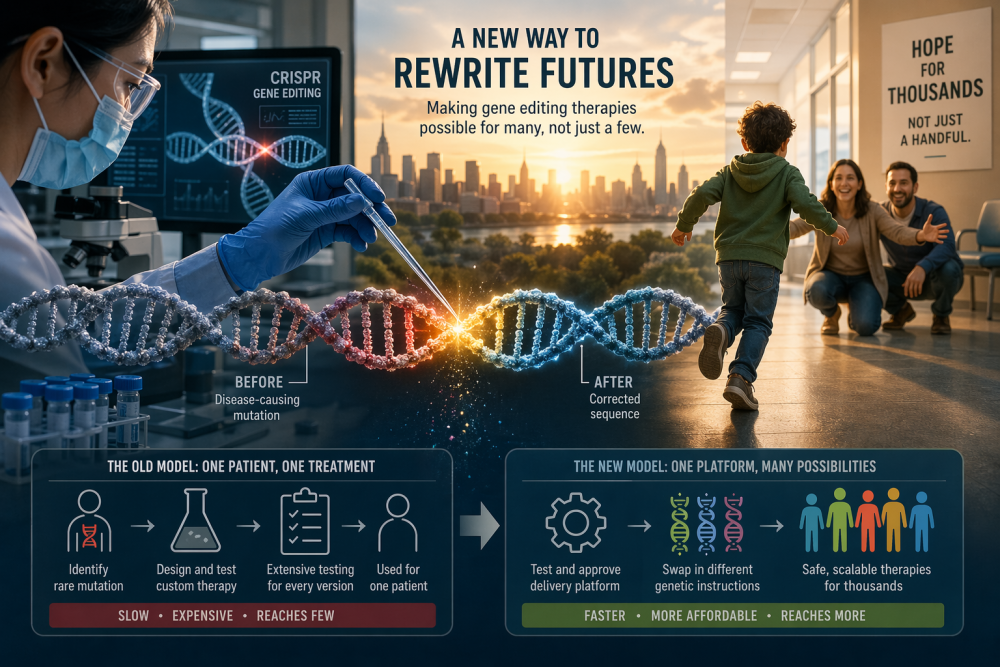
19/2026
A child born with a rare genetic disease might receive a custom-made treatment, a tiny molecular fix tailored to them. These therapies, powered by tools such as CRISPR, can correct DNA errors that cause devastating illnesses. But there has always been a catch: each treatment is so personalized and painstakingly crafted that it is often too expensive and too slow to reach more than a handful of patients.
Now, scientists say they may have found a way to change that.
A new approach to testing and approving these treatments could make personalized gene editing not just possible, but practical, opening the door for thousands of patients who were once left behind.
From One Patient to Many
Until now, each CRISPR therapy has been treated almost like a one-of-a-kind experiment. Regulators require extensive testing for every individual version, even if the only difference is a tiny tweak in the genetic code.
Imagine building a new car from scratch every time you wanted to change the color.
The new idea flips that model.
Instead of evaluating each therapy separately, researchers propose testing a platform, a kind of standardized system for delivering gene edits. Once the platform is proven safe, doctors could swap in different genetic “instructions” without having to start over each time.
Why It Matters?
Rare genetic diseases are, by definition, uncommon. Some affect only a few dozen people worldwide. That makes traditional drug development, which depends on large clinical trials, nearly impossible.
The result? Thousands of conditions remain untreated, not because science lacks solutions, but because the system cannot support them.
This new framework could change the treatment cost entirely.
By making it feasible to produce therapies at scale, even for small patient groups, scientists believe personalized medicine could finally live up to its promise: treatments designed for individuals yet available to many.
The Human Stakes
Behind every technical breakthrough is a story.
A child who cannot walk.
A teenager whose immune system fails.
A family waiting for something, anything, that might help their loved one.
For these patients, time is not an abstract concept. It is measured in symptoms, in hospital visits, in quiet moments of uncertainty.
Gene editing offers something rare in medicine: not just treatment, but the possibility of a cure, a single intervention that corrects the root cause, rather than managing the symptoms.
Until now, that possibility has been out of reach for most.
The Road Ahead
Of course, this is not a magic switch.
Regulators will need to adapt. Scientists must ensure safety across different genetic variations. And ethical questions about access, cost, and equity will only grow louder as technology advances.
But the direction is clear.
Medicine is shifting from a world of mass-produced drugs to one of precision, where treatments are tailored, flexible, and increasingly personalized.
And if this new approach succeeds, the phrase “too rare to treat” may one day disappear from the medical vocabulary.
In a laboratory somewhere, a strand of DNA is being edited carefully and deliberately, in hopes of correcting a life’s blueprint.
For the first time, that hope might not be limited to just one patient.
It might belong to thousands.
Reflecting on this breakthrough, Prof. Dr. Muhammad Mukhtar emphasizes that today’s progress rests on decades of foundational scientific work. In the early days, pioneering research helped usher gene therapy from theoretical promise into clinical trials, a milestone that once seemed distant.
What is unfolding now, he observes, is even more remarkable: the transition from experimentation to real-world translational medicine. Gene therapy is no longer confined to laboratories or limited trials; it is increasingly a practical tool for treating genetic disorders.
A central challenge in those earlier years was delivery, specifically, safely and effectively transporting therapeutic genes into human cells. That bottleneck slowed progress and raised safety concerns. Today, advances in CRISPR are reshaping that landscape, offering a more precise and comparatively safer approach to editing the human genome.
In his view, this moment represents not just scientific success, but continuity, a powerful reminder that today’s breakthroughs are built on yesterday’s persistence.