The Rise of the AI Scientist: Your Next Research Partner Won't Wear a Lab Coat
Posted 2 months ago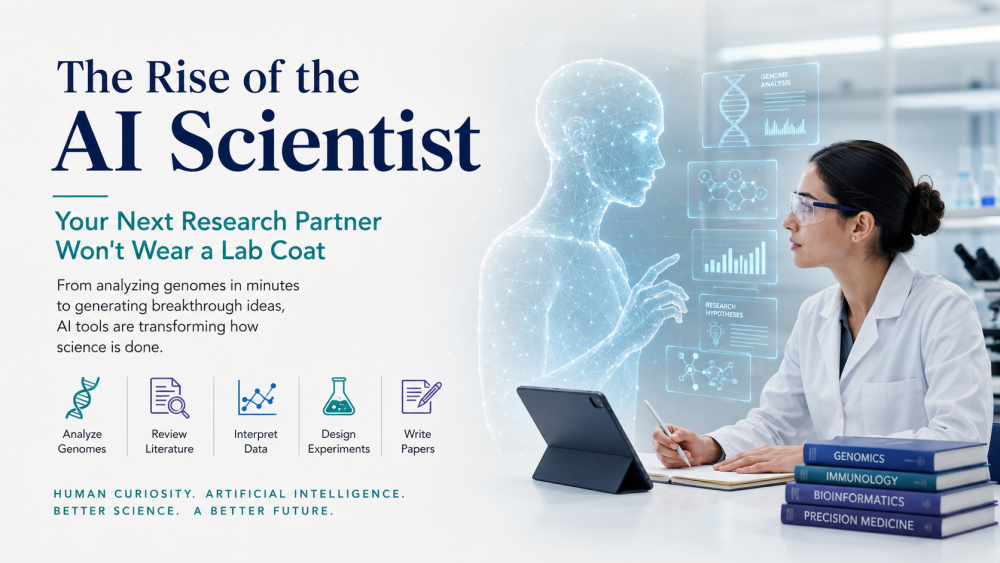
44/2026
Artificial intelligence is transforming scientific discovery, from analyzing genomes in minutes to generating groundbreaking research ideas. But can it truly think like a scientist?
Imagine spending nine months solving a scientific puzzle with a team of more than 30 experts. Now imagine a computer completing the same task in just half an hour.
That is no longer science fiction.
According to a Nature article, Professor Euan Ashley, a physician and geneticist at Stanford University, asked an artificial intelligence system called Claude Science to analyze his complete human genome—the same analysis that, in 2010, required 31 researchers and nine months of painstaking work. Within 30 minutes, the AI identified key genetic variations linked to Alzheimer's disease risk and to how his body processes certain medicines.
For scientists, it was a glimpse into a future that is arriving much faster than anyone expected.
Meet the "AI Scientist"
Most people are familiar with AI chatbots such as ChatGPT, Gemini, or Claude. They answer questions, write emails, and summarize documents.
The new generation of scientific AI goes much further.
These systems are often called AI scientists because they don't simply answer questions; they can help researchers review thousands of scientific papers, analyze complex data, suggest new experiments, prepare figures, draft research manuscripts, and even generate entirely new scientific hypotheses.
Rather than replacing researchers, they function as exceptionally fast research assistants who never tire and can work around the clock.
A Digital Laboratory Assistant
Think of an AI scientist as a highly organized assistant working in a laboratory.
A researcher might ask:
"Find everything published about a rare genetic disease during the last five years."
Instead of spending days searching scientific databases, the AI gathers the information within minutes.
Another scientist might upload genetic data collected from patients.
Instead of manually examining millions of DNA sequences, the AI quickly identifies unusual patterns and flags findings that warrant closer investigation.
Some AI systems can even coordinate multiple specialized software tools, almost like a project manager assigning tasks to different experts.
More Than Just Searching for Information
One of the most exciting developments is that AI is beginning to help scientists generate new ideas.
Researchers at the University of Cambridge used Google's Co-Scientist AI while studying how the immune system responds to infectious diseases.
The AI proposed several possible experiments.
Some suggestions were unrealistic.
Others turned out to be surprisingly practical.
One idea was so promising that the research team is now testing it in the lab. The scientists believe they might eventually reach the same conclusion—but perhaps only after two years of additional work.
That is where AI may prove most valuable: not by replacing creativity, but by accelerating it.
Different AI Scientists for Different Jobs
Just as hospitals have surgeons, radiologists, and pharmacists, today's scientific AI systems have different strengths.
Some are excellent at reviewing scientific literature.
Others specialize in analyzing genomes.
Some assist in designing proteins and antibodies for future medicines.
Others help prepare research papers or visualize complex scientific results.
Experts therefore recommend that researchers choose AI tools based on the specific task rather than expecting one system to do everything perfectly.
Trust but Always Verify
Despite the excitement, scientists agree on one important rule:
Never accept AI answers without checking them.
A New Era of Human-AI Collaboration
Rather than replacing researchers, AI is changing how science is done.
Scientists may soon spend less time searching databases, formatting manuscripts, or processing massive datasets, and more time asking bold questions, designing better experiments, and interpreting discoveries.
As one researcher described it, AI allows scientists to spend their time on "the science that truly needs a human."
That may ultimately become artificial intelligence's greatest contribution—not replacing curiosity but giving human curiosity more time to flourish.
Why This Matters for Pakistan
For countries such as Pakistan, AI scientists represent a remarkable opportunity.
According to Professor Emeritus Dr. Muhammad Mukhtar, Rector of the University of Southern Punjab, Multan, many universities face shortages of funding, laboratory infrastructure, and experienced researchers. AI-powered scientific assistants can help level the playing field by enabling faculty members and students to analyze data more quickly, review global research more efficiently, and generate innovative research ideas without requiring large research teams.
However, adopting these technologies also requires investment in digital infrastructure, AI literacy, and research ethics. Universities should teach students not only how to use AI effectively but also how to evaluate its output and uphold scientific integrity.
The future of research will not belong to scientists or artificial intelligence alone. It will belong to those who learn how to combine the strengths of both.
As laboratories around the world embrace this new generation of AI scientists, one thing is becoming increasingly clear: the next great scientific breakthrough may emerge not from a machine working alone, nor from a human working alone, but from an intelligent partnership between the two.