Dementia Is Not Destiny: What Science Really Tells Us About Protecting the Aging Brain?
Posted 2 months ago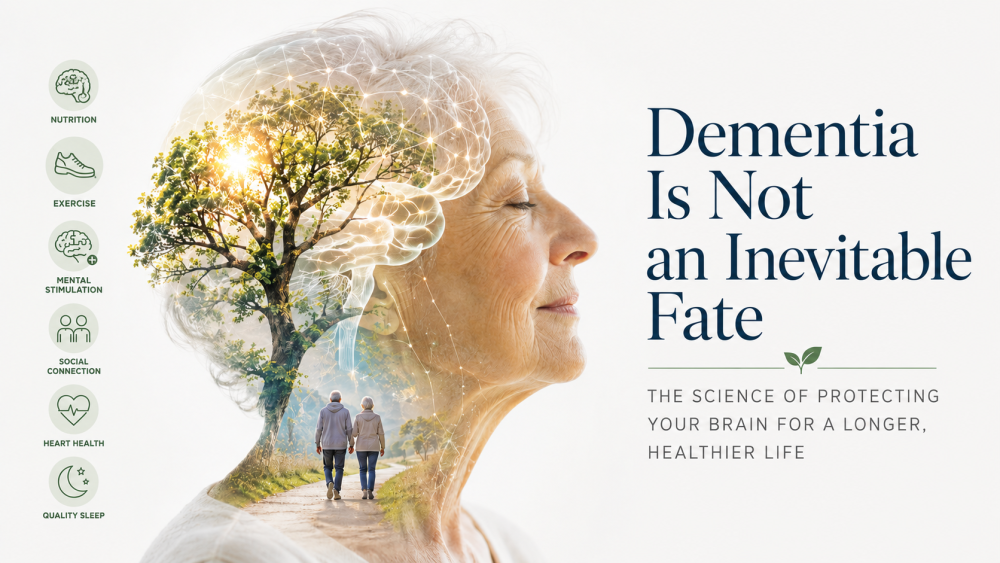
43/2026
There may be no organ more mysterious than the human brain. It stores a lifetime of memories, orchestrates every thought and emotion, and continuously rewires itself in response to experience. Yet as age advances, this remarkable organ becomes increasingly vulnerable to diseases that gradually erode memory, reasoning, language, and identity. Among these disorders, dementia remains one of the greatest medical and social challenges of the twenty-first century.
For many families, dementia feels like an unavoidable consequence of growing older. Popular culture often reinforces this belief, while sensational headlines alternately promise miracle cures or warn that nothing can be done. Modern neuroscience offers a far more nuanced picture. Dementia is neither an inevitable destiny nor a condition that can be completely prevented by healthy living. Instead, it arises from a complex interplay of genetics, vascular health, immune function, environmental exposure, education, and decades of accumulated lifestyle choices. The emerging scientific consensus is both realistic and encouraging. However, no single intervention can guarantee protection; many factors can strengthen the brain's resilience and delay the onset or reduce the severity of cognitive decline.
This shift in understanding represents one of the most important advances in contemporary brain research.
Worldwide, more than 57 million people were living with dementia in 2019, and the number is expected to increase dramatically with the aging of populations. The growing burden extends well beyond healthcare systems. Families become caregivers, economies absorb enormous costs, and societies face difficult questions about long-term care, independence, and quality of life. Against this backdrop, researchers are moving beyond the search for a single cure and instead exploring how lifelong brain health can reduce vulnerability to disease.
One of the most important lessons from recent research is that dementia develops over decades rather than months. Long before the first symptoms appear, subtle biological changes are already underway in the brain. Proteins begin to accumulate abnormally, inflammation quietly persists, tiny blood vessels become damaged, and communication between neurons gradually weakens. By the time memory problems become noticeable, these processes may have been unfolding for twenty years or more.
This long silent phase creates an important opportunity. It suggests that protecting brain health should begin in early and middle adulthood, not only after retirement.
Scientists increasingly describe this protection as building cognitive reserve. Rather than preventing every pathological change, cognitive reserve enables the brain to continue functioning flexibly and efficiently. Individuals who spend their lives learning new skills, reading, solving problems, engaging in intellectually demanding work, speaking multiple languages, or maintaining rich social interactions appear to develop more flexible and efficient neural networks. These networks provide alternative pathways for processing information when some brain circuits become damaged.
The concept helps explain why two people with similar levels of Alzheimer's pathology can exhibit markedly different symptoms. One individual may continue living independently for years, while another develops significant impairment much earlier. The difference often lies not simply in disease burden but in the brain's capacity to compensate.
Physical activity is another pillar of brain resilience. Exercise does far more than strengthen muscles or improve cardiovascular fitness. It enhances blood flow to the brain, stimulates the release of growth factors that support neuronal survival, reduces chronic inflammation, improves insulin sensitivity, and promotes the formation of new neural connections. Animal studies even show increased neurogenesis, the birth of new neurons in brain regions involved in memory.
Importantly, the benefits do not require elite athletic performance. Regularly engaging in moderate activities such as walking, swimming, cycling, resistance training, and gardening appears sufficient to support healthier brain aging. The evidence repeatedly shows that consistency matters more than intensity.
Cardiovascular health has emerged as an equally powerful determinant of cognitive aging. The brain accounts for only about 2% of body weight, yet consumes about 1/5 of the body's oxygen and energy. Its dependence on an uninterrupted blood supply makes it especially vulnerable to hypertension, diabetes, obesity, elevated cholesterol, smoking, and vascular disease.
Neurologists increasingly summarize this relationship in a simple phrase: what protects the heart also protects the brain.
This perspective has transformed dementia research. Alzheimer's disease is no longer viewed solely as a disorder of abnormal protein accumulation. Growing evidence indicates that vascular injury, metabolic dysfunction, inflammation, and impaired waste clearance all contribute to disease progression. Consequently, controlling blood pressure, maintaining healthy blood sugar, avoiding tobacco, and preserving cardiovascular fitness may reduce long-term cognitive risk while protecting other organs.
Nutrition offers another important piece of the puzzle, though scientific evidence is often misunderstood. Public enthusiasm often centers on individual "superfoods," or dietary supplements claimed to prevent memory loss. Researchers, however, increasingly emphasize overall dietary patterns rather than isolated nutrients.
Diets rich in vegetables, fruits, legumes, whole grains, fish, nuts, and healthy oils consistently correlate with healthier cognitive aging. These eating patterns appear to reduce inflammation, support vascular integrity, improve metabolic health, and foster beneficial gut microorganisms that communicate with the brain via immune, hormonal, and neural pathways. Emerging research on the gut-brain axis suggests that microorganisms in the digestive tract may influence cognition more profoundly than previously imagined.
Yet scientists remain appropriately cautious. Correlation alone cannot establish causation, and no specific food has been proven to eliminate the risk of dementia. Healthy diets should therefore be viewed as one component of a broader strategy rather than a standalone solution.
Perhaps one of the most surprising discoveries in recent years concerns hearing and vision. Untreated sensory impairment has emerged as a significant contributor to cognitive decline. When hearing loss impairs communication, individuals often withdraw from conversations and social activities. At the same time, the brain must devote more cognitive resources to interpreting degraded sounds, leaving fewer for memory and reasoning.
Correcting hearing loss with appropriate interventions may therefore preserve not only communication but also cognitive engagement. Similar principles apply to vision, underscoring that brain health depends on the quality of information continuously entering the nervous system.
Sleep has likewise become a central focus of neuroscience. During deep sleep, the brain activates specialized waste-removal systems that help clear metabolic by-products, including proteins associated with Alzheimer's disease. Chronic sleep deprivation disrupts these processes, increases inflammation, and impairs memory consolidation.
Modern lifestyles characterized by excessive screen exposure, irregular work schedules, and chronic stress increasingly interfere with restorative sleep. Protecting sleep may therefore represent one of the simplest and most overlooked investments in long-term brain health.
Social connection also deserves recognition as a biological necessity, not merely an emotional preference. Human brains evolved within communities. Conversations, shared experiences, emotional support, and meaningful relationships continually stimulate neural circuits involved in language, empathy, attention, and executive function.
Conversely, prolonged loneliness has measurable physiological consequences, including elevated stress hormones, heightened inflammation, and reduced cognitive stimulation. Maintaining social engagement throughout life appears to help preserve mental function and improve overall well-being.
None of these observations diminish the importance of genetics. Certain inherited variants substantially increase susceptibility to Alzheimer's disease, particularly the APOE ε4 allele. However, genetics rarely operates in isolation. It influences probability rather than certainty. Even among individuals carrying high-risk genetic variants, lifestyle and environmental factors continue to shape health outcomes.
This understanding has significant implications for public health. Rather than asking whether dementia can be completely prevented, scientists increasingly ask how many years of healthy cognitive life can be gained through combined interventions. Even delaying dementia onset by a few years could dramatically reduce the number of affected individuals worldwide while preserving independence and quality of life for millions of older adults.
Large international clinical studies evaluating multidomain lifestyle interventions reflect this evolving philosophy. These investigations combine nutritional guidance, structured physical activity, cognitive training, cardiovascular risk management, and social engagement. Although the improvements observed thus far have generally been modest, they consistently suggest that comprehensive approaches can enhance cognitive performance and overall brain health. Researchers continue to investigate whether these benefits ultimately translate into lower dementia incidence over longer follow-up periods.
The most important message from this work is one of balanced optimism. Science has not yet discovered a cure for Alzheimer's disease or other forms of dementia, nor has it identified a single behavior that guarantees lifelong cognitive health. What it has revealed is equally valuable: the brain remains biologically responsive throughout life. Every healthy meal, every brisk walk, every intellectually stimulating conversation, every well-managed blood pressure reading, every restful night's sleep, and every meaningful social interaction contributes incrementally to a healthier neural environment.
Brain aging is not determined by a single moment or a single gene. It reflects countless biological decisions that unfold over decades.
As populations continue to age, preserving cognitive health will require coordinated efforts by individuals, healthcare systems, educators, policymakers, and researchers. Investments in lifelong education, preventive healthcare, healthy urban environments, cardiovascular disease prevention, hearing care, and opportunities for social participation may ultimately prove as important as future pharmaceutical breakthroughs.
The future of dementia research is therefore shifting from treating irreversible disease to cultivating lifelong brain resilience.
That may be the most hopeful scientific discovery of all.