The Making of Champions: What the Polgar Sisters Reveal About Success
Posted 4 months ago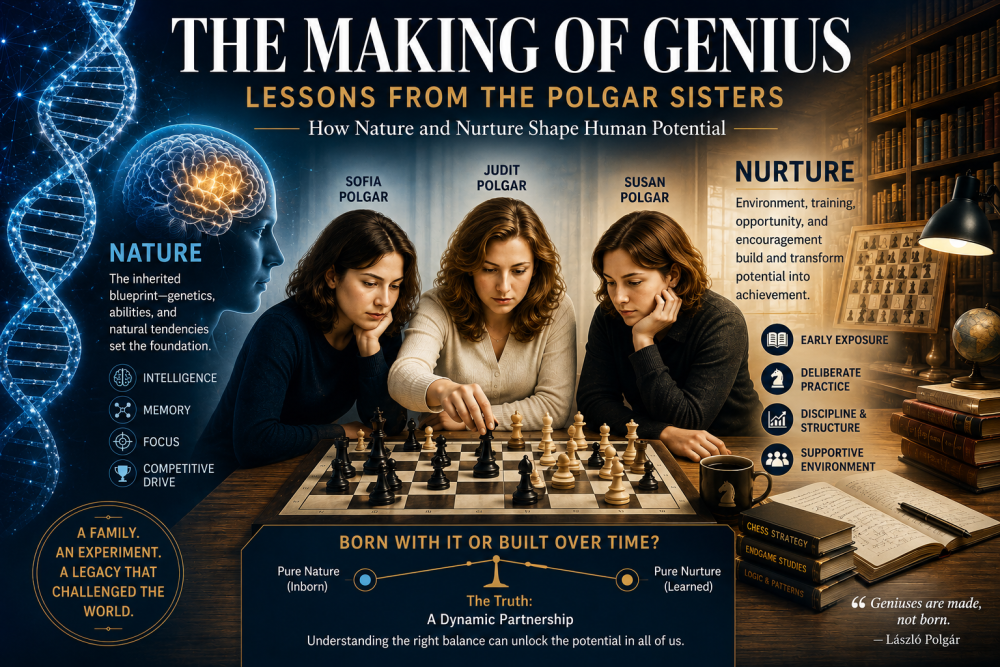
26/2026
Image Generated by ChatGPT
For centuries, humanity has wrestled with one of the most enduring questions in psychology and education: Are extraordinary people born with greatness, or can greatness be cultivated through environment and training?
A remarkable experiment by Hungarian psychologist László Polgár brought this debate into the global spotlight and challenged long-held assumptions about human potential.
Polgar firmly believed that exceptional achievement was not a gift reserved for a fortunate few. Long before becoming a father, he wrote that “geniuses are made, not born.” Determined to prove his theory, he and his wife designed an extraordinary educational experiment centered on their own children.
Their three daughters were homeschooled and introduced to chess at a very young age. The family environment centered on disciplined learning, constant practice, and intellectual growth. Day after day, the girls studied chess strategies, analyzed games, and competed in tournaments with relentless dedication.
The outcome astonished the world.
All three daughters became internationally celebrated chess players. Susan Polgar became a grandmaster. Sofia Polgar earned international recognition for her brilliant tournament performance. Most remarkably, Judit Polgar became the strongest female chess player in history, defeating elite male grandmasters and breaking records once held by legendary figures such as Bobby Fischer.
To many observers, the Polgar sisters became living proof that human excellence is largely shaped by nurture rather than nature. The famous “nature versus nurture” debate centers on whether human abilities arise primarily from genetics or from upbringing, education, and environment. The Polgar experiment appeared to strongly support the power of nurture, demonstrating how deliberate training and focused practice could transform ordinary children into world-class performers.
Yet the story did not end there.
Years later, science writer David Epstein revisited the Polgar case in his influential book Range. After studying athletes, scientists, inventors, musicians, and innovators across many fields, Epstein argued that the world may have misunderstood the deeper lesson of the Polgar sisters’ success.
According to Epstein, chess is what psychologists call a “kind environment.” In such environments, rules remain stable, feedback is immediate, and recognizable patterns recur. Every chess move produces clear consequences that can be analyzed quickly. The board never changes, and the pieces always behave according to fixed rules. With enough repetition, players gradually master thousands of recurring patterns, enabling expertise to develop rapidly through intense practice.
This explains why early specialization worked so effectively for the Polgar sisters. Chess rewards deep focus, repetition, and pattern recognition. In such structured environments, focused training from childhood can indeed produce extraordinary mastery.
However, Epstein found that most real-world professions operate very differently. Fields such as medicine, business, scientific research, leadership, and innovation exist in what psychologists call “wicked environments.” In these settings, rules constantly evolve, challenges are unpredictable, and feedback is often delayed or unclear. A strategy that succeeds today may fail tomorrow.
In such complex environments, narrow early specialization may not always be the best path to success.
Epstein found that many elite performers gained broad experience before eventually specializing. Tennis legend Roger Federer, for example, spent his childhood playing multiple sports, including soccer, badminton, basketball, handball, and table tennis, before focusing seriously on tennis. This diverse exposure strengthened his coordination, creativity, adaptability, and mental flexibility.
A similar pattern emerged in science and innovation. Many Nobel Prize winners actively pursued music, literature, or the arts alongside their scientific work. Great inventors often explored unrelated disciplines before making breakthrough discoveries. Diverse experiences often helped individuals connect ideas across fields and solve problems in original ways.
The broader lesson from the Polgar story is therefore more nuanced than a simple victory for either nature or nurture.
Genetics undoubtedly matters. Some individuals may naturally possess stronger memory, intelligence, concentration, or competitive drive. These inherited traits are part of human nature. Yet the Polgar experiment powerfully demonstrates that environment, encouragement, opportunity, and disciplined practice can profoundly shape human potential. The sisters succeeded not merely because of talent but because they grew up in a home carefully designed to foster learning and improvement.
At the same time, Epstein’s research reminds us that different fields reward different developmental paths. Highly structured domains, such as chess or classical music, may favor early, focused training. In contrast, unpredictable, creative professions often reward curiosity, exploration, and broad exposure to multiple disciplines.
Perhaps the most powerful conclusion is this: finding the right fit matters more than starting early. Many successful individuals spend years exploring different interests before discovering the field where they truly thrive. Those experiences are rarely wasted. Each one builds knowledge, perspective, adaptability, and creativity that later prove invaluable.
Modern society often glorifies child prodigies while viewing late bloomers as uncertain or unfocused. Yet growing evidence suggests that those who explore widely before committing to a single path may ultimately be more innovative, resilient, and successful in today’s rapidly changing world.
The story of the Polgar sisters ultimately offers a balanced, deep human understanding of achievement. Human potential is shaped by both nature and nurture. Natural ability provides a foundation, but environment, discipline, encouragement, and opportunity can dramatically expand what individuals can become. Some journeys require early specialization and intense focus, while others flourish through curiosity, experimentation, and a broad range of experiences.