Prof. Mukhtar’s Reflection on the Long Journey of Brain Transplantation Research - A Paper published in Nature Journal
Posted 14 hours ago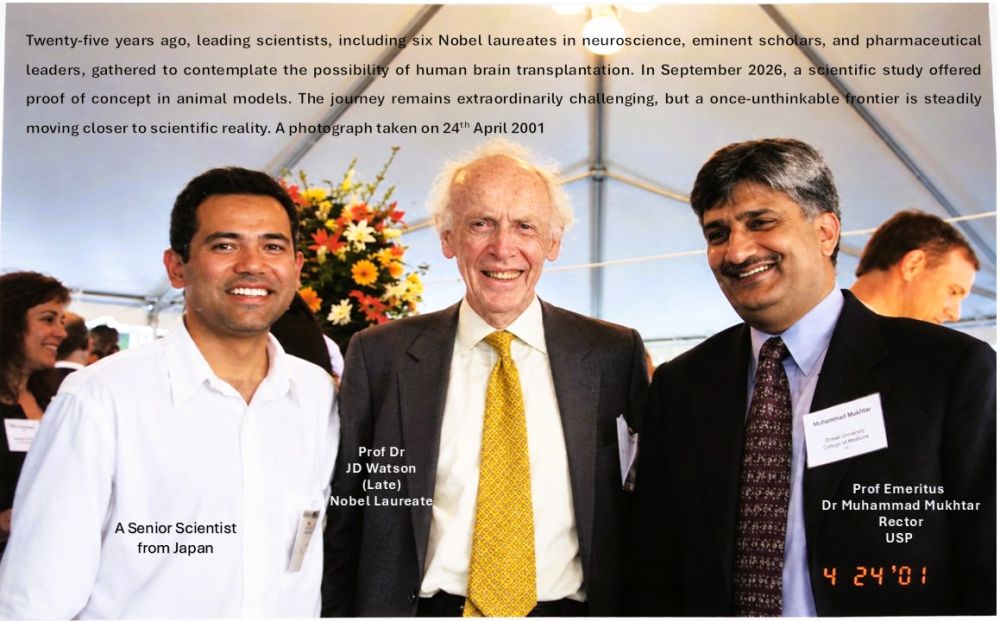
59/2026
A remarkable new experiment is giving scientists an unprecedented opportunity to study human brain cells in a living brain. Researchers have transplanted laboratory-grown human brain tissue into specially engineered mice, where the human cells survived, expanded, and formed extensive connections with the animals’ nervous systems. Nature Journal describes the work as the most extensive reported integration of human brain cells into an animal to date.
Prof. Dr. Muhammad Mukhtar, Rector of the University of Southern Punjab, Multan, Pakistan, recalled that nearly twenty-five years ago, Cogent Neuroscience brought together six Nobel laureates in neuroscience, leading scientists, and pharmaceutical companies to explore a question that once seemed almost beyond modern medicine: could damaged areas of the human brain be repaired or replaced by transplanting healthy neural tissue?
At the time, the prospect was extraordinarily challenging. The human brain is an exceptionally delicate and highly interconnected organ, and successfully introducing new brain cells requires not only their survival but also their precise integration into existing neural networks. The remarkable complexity of these biological processes has meant that progress has necessarily been gradual.
Prof. Dr. Mukhtar noted that the recent demonstration of human brain tissue successfully integrating into the brains of mice is an encouraging development in this long scientific journey. While substantial research remains before such approaches could be considered for human therapeutic applications, the ability of transplanted human neural tissue to survive, develop, and form extensive connections provides valuable evidence for researchers to build on.
Dr. Muhammad Mukhtar's pioneering work in human in vitro blood–brain barrier (BBB) modeling has advanced understanding of one of the brain's most important protective systems. The blood–brain barrier regulates which substances can move from the bloodstream into the brain and plays a crucial role in both normal brain function and neurological disease. This research is particularly significant for understanding neurodegenerative disorders and the mechanisms by which viruses and other biological agents may cross into the brain. A better understanding of the BBB could ultimately help scientists develop improved strategies for drug delivery, disease modeling, and therapeutic intervention.
Reflecting on the field's evolution, Prof. Dr. Mukhtar emphasized that today's achievements reflect decades of persistent scientific inquiry. What was once a highly speculative discussion among leading scientists has gradually evolved into sophisticated experimental approaches that can test aspects of brain tissue transplantation in living systems.
The recent findings therefore mark not an endpoint but another important milestone in a decades-long quest to understand, protect, and potentially repair the human brain.