Is Technology Destroying Our Attention Span? What Science Says....
Posted 5 months ago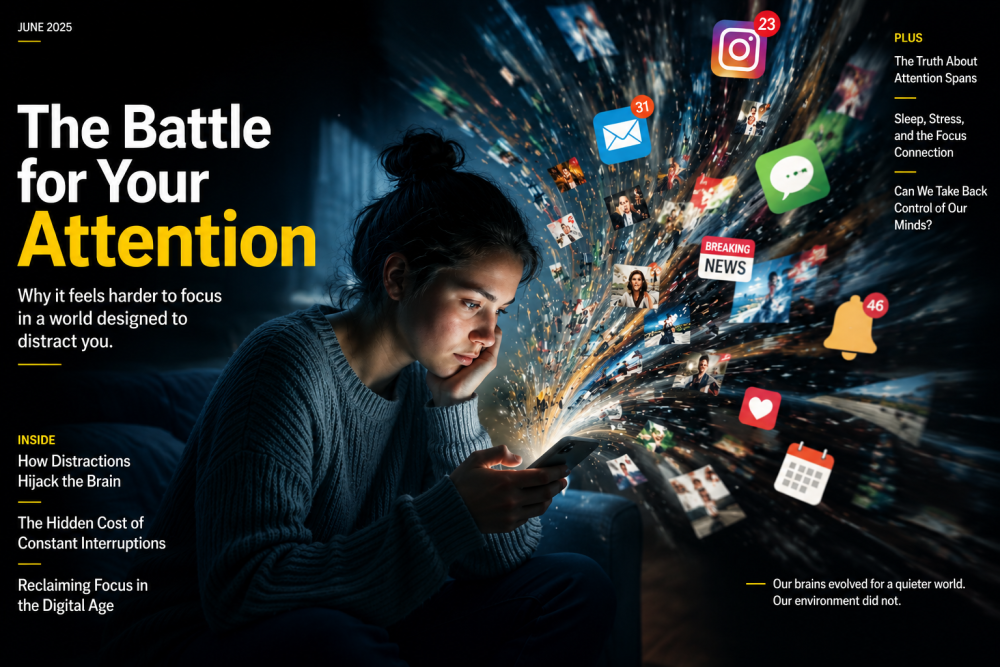
24/2026
Everywhere we look, people are worried about attention spans. Parents blame smartphones, teachers complain that students cannot focus, and many adults feel their minds constantly jump from one thing to another. Social media videos are getting shorter, notifications never stop, and multitasking has become part of everyday life.
This has led to a widespread belief that modern humans now have “shorter attention spans” than ever before.
But according to recent scientific discussions published in the journal Nature, the reality is far more complex. Researchers say our brains may not be losing the ability to pay attention. Instead, the modern world is fighting harder than ever to capture it.
Attention Has Always Been Under Attack
Distraction is not a new problem created by TikTok or smartphones. More than a century ago, inventors and writers were already discussing how difficult it was for people to concentrate. One inventor even created a strange wooden “isolation helmet” to block outside distractions and help people focus better.
This shows that humans have always struggled to maintain focus. What has changed today is the sheer volume of distractions vying for our attention every second.
Emails, social media alerts, breaking news, online videos, advertisements, and endless scrolling platforms constantly compete for our attention.
Deficiency is not in the brain - Unfortunately, The Environment Is Overloaded
Scientists say there is little strong evidence that the human brain’s core attention capacity has permanently declined. Instead, our surroundings have become much noisier and more mentally demanding.
Imagine attention as a flashlight in a dark room. It still functions, but modern life constantly presents thousands of moving objects in front of it.
The result?
- People feel mentally exhausted
- Focus becomes fragmented
- Tasks take longer
- Concentration feels harder
This does not necessarily mean the brain is damaged. It may be overloaded.
Smartphones Are Part of the Problem
Researchers have found that smartphones can affect concentration even when they are not actively in use. Simply seeing a phone nearby can reduce mental focus because part of the brain remains alert for possible notifications or messages.
This explains why many people instinctively check their phones every few minutes, even when they receive no alerts.
Social media platforms are also carefully designed to keep users engaged through:
- Infinite scrolling
- Personalized content
- Short videos
- Instant rewards
- Notifications and likes
These systems train the brain to seek novelty and stimulation constantly.
Multitasking Is Not Always Efficient
Many people believe they are good at multitasking, but studies suggest the human brain performs better when focusing on one task at a time. Constantly switching between activities can reduce productivity and increase mistakes.
For example:
- Replying to messages during meetings
- Studying while watching videos
- Driving while checking notifications
- Working while constantly switching browser tabs
Each interruption forces the brain to “reset,” consuming mental energy.
Attention Span Depends on Interest
One important finding from psychological research is that attention is strongly linked to motivation and interest.
People who struggle to focus during long meetings may still spend hours watching sports, gaming, reading novels, or solving problems they enjoy solving.
This suggests humans are not necessarily losing attention; they are becoming more selective about where they direct it.
Stress, Sleep, and Mental Health Matter Too
Scientists emphasize that modern attention problems are not caused solely by technology.
Other major contributors include:
- Poor sleep
- Stress
- Anxiety
- Burnout
- Noise pollution
- Information overload
Lack of sleep alone can significantly impair concentration, memory, and decision-making.
In many cases, people who blame “short attention spans” may actually be experiencing mental fatigue.
Can We Improve Focus Again?
The encouraging news is that attention can be strengthened and protected.
Experts recommend:
- Turning off unnecessary notifications
- Taking breaks from social media
- Sleeping properly
- Practicing mindfulness
- Reading longer-form content
- Working in distraction-free environments
- Doing one task at a time
Even small habits can help the brain recover deeper concentration.
The Bigger Question: Who Controls Our Attention?
Scientists say attention has become one of the most valuable resources in the digital economy. Technology companies compete aggressively for human focus because attention drives advertising, engagement, and profit.
In simple terms:
If something captures your attention, it captures your time.
This is why apps and platforms are engineered to keep users constantly engaged.
The Bottom Line
Science does not fully support the idea that humans are biologically losing the ability to concentrate. Instead, modern life is placing unprecedented pressure on our attention systems.
Our brains may still be capable of deep focus, but they now operate inside a world designed to interrupt them continuously.
The challenge of the future may not be whether humans can pay attention.
It may be whether we can