What Exactly Is a Medical Device? A Practical Guide to Modern Healthcare Technology
Posted 21 hours ago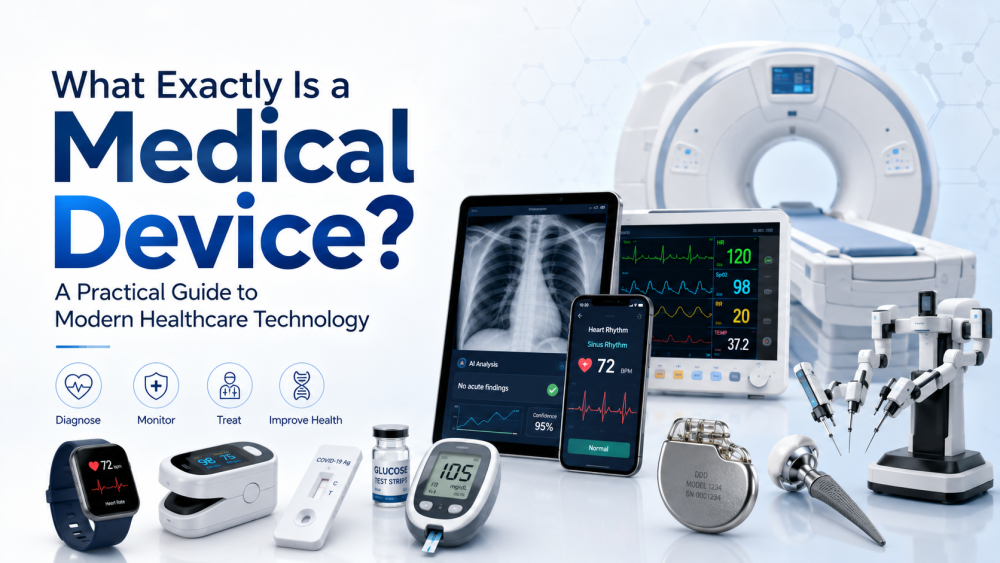
37/2026
Modern healthcare relies heavily on medical devices. From the stethoscope around a physician's neck to sophisticated MRI scanners, implantable pacemakers, COVID-19 test kits, and even certain smartphone applications, medical devices play an indispensable role in diagnosing, monitoring, treating, and improving human health.
Yet many people are surprised to learn that the term "medical device" encompasses far more than traditional hospital equipment. In fact, medical devices span an extraordinarily diverse range of technologies, materials, software systems, and diagnostic tools. Understanding what qualifies as a medical device is essential for healthcare professionals, engineers, entrepreneurs, regulators, and patients alike.
What Is a Medical Device?
According to international standards such as ISO 14971, a medical device is any instrument, apparatus, machine, implant, reagent, software, material, or related article intended by the manufacturer for use in humans for a specific medical purpose.
This definition may seem broad and intentionally so. Medical technology continues to evolve rapidly, and regulations must accommodate everything from simple thermometers to artificial intelligence-powered diagnostic platforms.
In essence, a medical device must satisfy three key criteria:
1. It Must Be a Device
A medical device can take many forms, including:
- Instruments such as stethoscopes and surgical tools
- Machines such as MRI scanners and dialysis systems
- Implants such as pacemakers and artificial joints
- Diagnostic kits such as pregnancy and COVID-19 tests
- Software applications used in healthcare
- Specialized materials such as dental filling compounds
The definition is intentionally expansive to ensure that innovative healthcare technologies are appropriately regulated.
2. It Must Serve a Medical Purpose
The intended use of a product is perhaps the most important factor in determining whether it is a medical device.
Medical purposes may include:
- Diagnosing diseases
- Preventing illnesses
- Monitoring patient conditions
- Treating injuries
- Supporting physiological functions
- Replacing damaged anatomy
- Sustaining life
- Assisting reproduction
- Providing diagnostic information from biological samples
A device does not become medical merely because it is technologically advanced. Rather, it becomes medical because of the purpose for which it is intended and marketed.
3. It Is Not a Drug
Medical devices are distinct from pharmaceuticals.
Unlike drugs, which achieve their primary effects through pharmacological, immunological, or metabolic action, medical devices generally operate through physical, mechanical, electrical, or informational means.
For example:
- A pacemaker regulates heart rhythms electrically.
- An MRI scanner uses magnetic fields to create images.
- A surgical laser removes tissue through focused light energy.
Although some devices may work alongside medications, their primary mode of action is not drug-based.
Medical Devices Diversity
The spectrum of medical devices extends far beyond hospital wards.
Diagnostic Technologies
Diagnostic devices help healthcare professionals identify diseases and injuries. Examples include:
- MRI scanners
- CT scanners
- Ultrasound systems
- EEG monitors
- Blood testing equipment
These technologies provide critical information that guides medical decision-making.
Implantable Devices
Some medical devices are implanted inside the body to restore function or support life.
Examples include:
- Cardiac pacemakers
- Implantable cardioverter defibrillators (ICDs)
- Artificial joints
- Breast implants
Many of these devices remain in patients for years and require stringent safety standards.
In Vitro Diagnostic Devices
The term "in vitro" refers to tests performed outside the body using biological samples.
Examples include:
- COVID-19 test kits
- Pregnancy tests
- Blood glucose testing systems
These devices analyze specimens such as blood, urine, or saliva to provide diagnostic information.
Software: The New Frontier of Medical Devices
One of the most significant developments in modern healthcare is the rise of medical software.
Many people associate medical devices with physical hardware. However, software itself can qualify as a medical device when it performs a medical function.
Examples include:
- Diagnostic mobile applications
- Clinical decision-support systems
- Telemedicine platforms
- AI-powered image analysis tools
Software as a Medical Device (SaMD)
A standalone software application that performs a medical function without being part of a specific hardware device is often classified as Software as a Medical Device (SaMD).
Examples include:
- Smartphone apps that detect heart rhythm abnormalities
- AI systems that analyze radiology images
- Web-based disease screening platforms
Software in a Medical Device (SiMD)
Software embedded within a physical medical device is known as Software in a Medical Device (SiMD).
Examples include software control:
- Surgical robots
- Ventilators
- Patient monitoring systems
- Radiation therapy equipment
As healthcare increasingly embraces artificial intelligence and digital health technologies, software regulation has become one of the fastest-growing areas of medical device oversight.
Qualifying as a Manufacturer of Medical Devices
An often-overlooked aspect of medical device regulation is the definition of a manufacturer.
Contrary to popular belief, the manufacturer is not necessarily the organization physically assembling the product. Instead, the manufacturer is the legal entity responsible for the device's design, production, quality, safety, and regulatory compliance.
For example, a startup company may outsource manufacturing to specialized contractors. Even though another company builds the device, the startup remains legally responsible for ensuring that all regulatory requirements are met.
This responsibility extends to:
- Product safety
- Clinical performance
- Quality management
- Regulatory compliance
- Post-market surveillance
Real-World Examples: Is It a Medical Device?
Determining whether a product is a medical device can be straightforward or surprisingly complex.
Clearly Medical Devices
These products are unquestionably medical devices:
✔ CT scanners
✔ MRI systems
✔ Hearing aids
✔ Stethoscopes
✔ Syringes used in healthcare
✔ Electrosurgical generators
Products in the Regulatory Gray Zone
Some products become medical devices only when certain features or claims are added.
Fitness Trackers
A basic fitness tracker that counts steps is generally not a medical device.
However, if it diagnoses heart disease or detects arrhythmias, it may be classified as a regulated medical device.
Massage Devices
A massage device marketed for relaxation is typically not a medical device.
If marketed to treat sciatica or specific medical conditions, it may fall under medical device regulations.
Hair Removal Systems
Consumer grooming devices are usually not medical devices.
However, sophisticated laser systems used by dermatologists in clinical settings may qualify as medical devices because of their therapeutic applications.
Smartphone Health Apps
Apps that track wellness metrics may not be medical devices.
Apps that diagnose diseases or provide treatment recommendations often are.
Why Intended Use Matters
The most important concept in medical device regulation is intended use.
Two products may look identical, but regulatory classification can differ dramatically depending on what the manufacturer claims the product can do.
A syringe used in baking is not a medical device.
The same syringe marketed for administering medication becomes a medical device.
Likewise, a smartwatch may be a consumer wellness product today but become a regulated medical device tomorrow if diagnostic features are introduced.
The Future of Medical Devices
Medical devices are rapidly evolving beyond traditional hardware. Artificial intelligence, wearable sensors, robotics, telemedicine platforms, and digital therapeutics are reshaping healthcare delivery worldwide.
As technology advances, the boundary between healthcare, consumer electronics, and software continues to blur. Regulatory frameworks are adapting to ensure that innovative products remain safe, effective, and beneficial to patients.
From life-saving implants to intelligent mobile applications, medical devices are becoming increasingly sophisticated and interconnected. Understanding what constitutes a medical device is therefore more important than ever for healthcare professionals, innovators, regulators, and the public.
The future of medicine will not be defined solely by drugs and therapies; it will also be shaped by the remarkable devices and digital technologies that help diagnose disease, support treatment, and improve quality of life for millions around the world.