Programming Biology: How Artificial Intelligence Is Rewriting the Future of Medicine
Posted 17 hours ago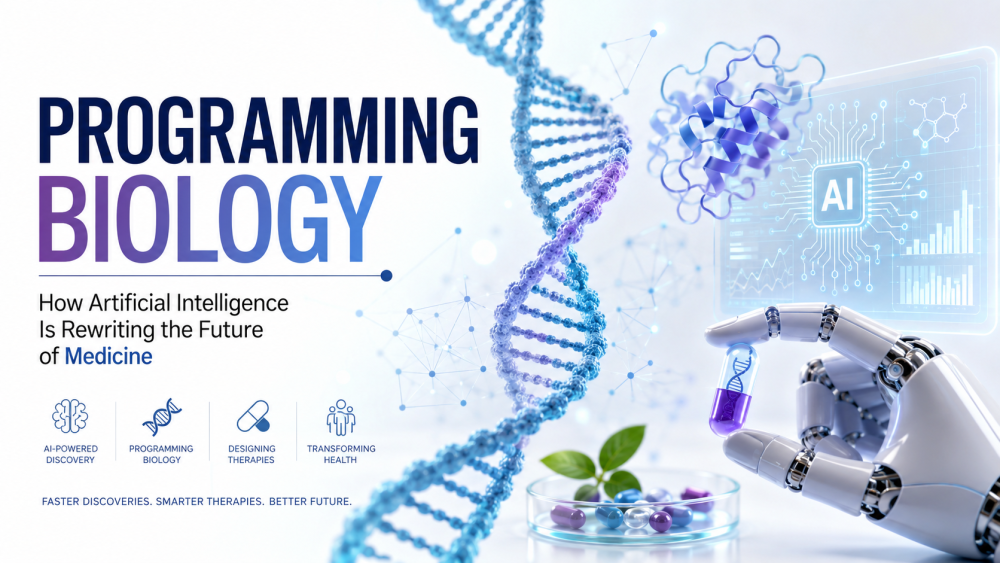
40/2026
According to an article in Nature Biotechnology, “Investors are showing tremendous confidence in the future of AI-driven biotechnology. In 2026, some of the biggest stock market launches, business partnerships, and investment deals involved companies using artificial intelligence to develop new medicines. One biotech firm, Generate Biomedicines, raised $400 million when it went public, while pharmaceutical giant Eli Lilly invested $115 million in a partnership with the AI-based drug discovery company Insilico Medicine. During the first three months of 2026 alone, AI-powered drug development companies attracted nearly $1.8 billion in venture capital funding, accounting for about one-quarter of all investments in the sector.”
For much of modern medical history, discovering a new drug has been a lengthy, costly, and highly uncertain endeavor. Researchers often spend years screening thousands of chemical compounds to find a single promising candidate. Today, however, a new wave of biotechnology companies is betting that artificial intelligence (AI) can fundamentally transform this process, enabling scientists to identify and design potential medicines faster, more efficiently, and with greater precision than ever before.
Investors seem convinced of AI’s power in medicine. Billions of dollars are flowing into AI-powered biotechnology startups that promise to design medicines faster, cheaper, and more accurately than ever. The vision is bold: instead of merely discovering drugs, researchers could one day “program biology” itself.
But while excitement is soaring, significant scientific and practical challenges remain.
What Does “Programming Biology” Mean?
The simplest definition of programming biology could be “the emerging science of treating living systems as programmable platforms, where genes, proteins, and cells can be designed, optimized, and controlled using a combination of biotechnology, engineering, and artificial intelligence. The goal is to move beyond merely understanding biology to actively engineering it for human health, agriculture, and industry”.
Computers have transformed industries from finance to transportation. Now, researchers want to apply similar principles to living systems.
Biology can be viewed as a vast information network. DNA contains instructions, proteins carry out tasks, and cells communicate via complex molecular signals. AI systems are increasingly capable of analyzing these large datasets and identifying patterns that humans might miss.
Rather than testing millions of compounds in a laboratory, AI can predict which molecules are most likely to be effective before experiments even begin. This could save years of research and hundreds of millions of dollars.
In simple terms, scientists are trying to move from "discovering" medicines to "designing" them.
AI’s Expanding Role in Drug Discovery
The first wave of AI in biotechnology focused on accelerating drug discovery. Today, companies are aiming much higher.
Modern AI systems can:
- Predict protein structures
- Design entirely new therapeutic molecules
- Identify promising drug targets
- Analyze patient data to personalize treatments
- Simulate biological processes before laboratory testing
The success of protein-structure prediction tools demonstrated that AI could solve biological problems once considered extremely difficult. This achievement inspired a surge of investment in companies seeking to apply similar approaches across medicine.
The Rise of “Programmable Medicines”
One of the most exciting ideas emerging from AI biotechnology is the concept of programmable therapeutics.
Precision medicines typically perform a single task. Future therapies may be designed like software, with biological instructions engineered to respond to specific conditions within the body.
Imagine a treatment that activates only in cancer cells and remains inactive elsewhere. Or a therapy that adapts its behavior to a patient's molecular profile.
Such capabilities remain largely experimental, but many researchers believe AI could accelerate their development by enabling scientists to understand and manipulate biological systems with unprecedented precision.
Why Investors Are Pouring in Billions
The pharmaceutical industry invests enormous sums in research and development. Yet most drug candidates fail before reaching patients.
Even small efficiency improvements can generate huge financial returns.
This explains why venture capital firms and major pharmaceutical companies are investing heavily in AI-driven biotechnology platforms. Funding for AI-enabled drug discovery companies has grown rapidly as investors hope these technologies will reduce failure rates and shorten development timelines.
The appeal is clear: faster discoveries, lower costs, and potentially better treatments.
The Data Problem
Despite the enthusiasm, biology remains far more complicated than many AI applications.
Unlike internet data, biological information is often incomplete, noisy, and difficult to standardize. Human biology varies widely across individuals, diseases, and environments.
AI systems are only as good as the data used to train them. If the data are limited or biased, predictions may fail when tested on real-world patients.
This challenge has become one of the biggest obstacles to AI-driven biotechnology. Researchers increasingly recognize that generating high-quality biological datasets may be as important as developing better algorithms.
AI cannot Replace Experiments.
A common misconception is that AI will eliminate laboratory research.
The reality is quite different.
AI can generate hypotheses and predictions, but those predictions must still be validated through experiments, clinical studies, and regulatory review. Biology often behaves in unexpected ways that no computer model can fully capture.
Scientists now view AI as a powerful partner rather than a replacement for human expertise. The most successful companies integrate advanced machine learning with robust experimental biology programs.
The Future of Drug Development
The biotechnology industry may be entering a new era.
Researchers increasingly describe biology as an information science, in which genes, proteins, and cells can be analyzed, modeled, and ultimately engineered with greater precision. AI provides tools that can process this complexity at a scale never before possible.
Although significant challenges remain, the direction is clear. The future of medicine will likely involve close collaboration between human scientists and intelligent machines.
The goal is not merely to create drugs faster. It is to understand life deeply enough to predict, prevent, and treat diseases with unprecedented precision.
If that vision becomes reality, programming biology could prove as transformative for medicine as programming computers was for the digital age.
Key Takeaways
- AI is rapidly transforming drug discovery and biotechnology.
- Investors are committing billions to AI-powered medicine platforms.
- Scientists aim to design, rather than merely discover, new therapies.
- High-quality biological data remains a major bottleneck.
- AI will augment, not replace, laboratory science.
- Programmable therapeutics could become one of the most important medical advances of the coming decades.