How Much of Your Personality Is Written in Your DNA? Science Has a New Answer
Posted 23 hours ago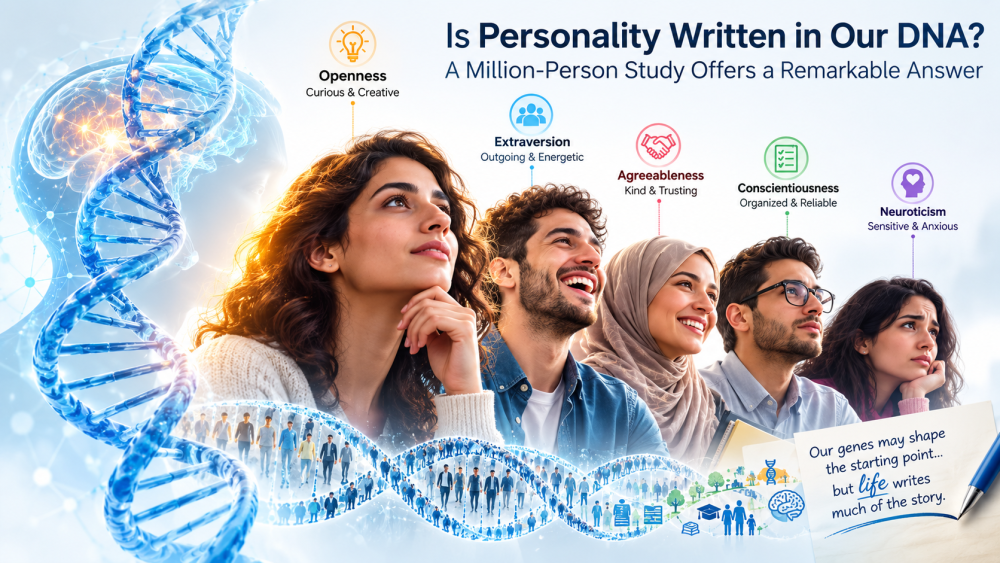
57/2026
Why are some people naturally outgoing while others are reserved? Why do some worry more, plan carefully, seek new experiences, or trust others easily?
For decades, psychologists have studied these differences within the framework of the “Big Five” personality traits. Now, one of the largest genetic studies ever conducted is providing an important new piece of the puzzle: our genes influence personality, but they are only part of the story.
A study in Nature analyzed genetic and personality data from more than one million people across 46 cohorts. Researchers identified 1,260 genetic variants associated with the Big Five personality traits, including 824 that had not been previously identified.
A companion Nature news article described the work as the greatest effort of its kind, highlighting how researchers are beginning to connect tiny differences in DNA with the ways people think, feel, and behave.
The Five Dimensions of Personality
The Big Five provides a useful framework for describing personality.
Extraversion reflects sociability, energy, and assertiveness.
Agreeableness includes compassion, trust, and cooperation.
Conscientiousness involves organization, responsibility, and self-discipline.
Neuroticism describes a tendency toward anxiety, emotional volatility, and negative emotions.
Openness to experience involves curiosity, imagination, and an attraction to new ideas and experiences.
These traits are not “types.” Most people fall somewhere along a spectrum. For example, someone can be moderately outgoing, highly conscientious, and quite anxious at the same time.
The new research asks a deeper question: how much of these differences can be traced to DNA?
There Is No Single “Personality Gene”
The answer is both fascinating and reassuring.
Researchers found that personality is influenced by thousands of genetic differences, each typically with a very small effect. The study estimated that common genetic variants account for roughly 4.8 to 9.3 percent of the variation in the Big Five traits in the main analyses. When measurement reliability is considered, estimates rise to roughly 9.3 to 13.3 percent.
This means that finding a genetic variant associated with extraversion does not allow scientists to look at someone's DNA and determine whether that person will be outgoing.
Instead, personality resembles a vast mosaic. Thousands of genetic pieces contribute subtle influences that interact with one another and with life experiences to shape the person we become.
That distinction is crucial.
Nature Is Not Destiny
Perhaps the most important message from the research is that genes do not determine personality.
The study authors note that genetic estimates from this study are considerably lower than those from traditional twin and family studies, which can capture additional genetic effects. Even those approaches, however, show substantial environmental influence.
Think of genes as a set of starting conditions rather than a finished blueprint.
A child may inherit tendencies that make them more cautious, energetic, curious, or emotionally sensitive. But parenting, education, friendships, culture, opportunities, trauma, economic circumstances, and countless other experiences can shape how those tendencies develop.
Two people can therefore share similar genetic tendencies and still grow into very different adults.
Why Study So Many People?
Personality genetics has historically been difficult to study because individual genetic effects are incredibly small.
The new study addressed part of that problem by combining data from 46 cohorts, involving approximately 611,000 to 1.14 million participants, for the different traits. Researchers examined millions of genetic markers across the genome.
The enormous sample produced a striking result: approximately 1,260 independent genetic variants reached the stringent statistical threshold used in genome-wide association studies, of which 824 represented previously unreported associations.
Importantly, the researchers found that the genetic signals were broadly consistent across different ages, countries, and personality questionnaires, and even between people's own assessments and those made by people close to them.
That strengthens the argument that the findings capture genuine biological influences rather than statistical quirks.
Personality May Also Shape Health and Behavior
The study becomes even more intriguing when researchers look beyond personality itself.
Genetic profiles associated with conscientiousness, for example, were linked to behaviors such as greater physical activity and lower substance use. These profiles were also linked to outcomes including lower body mass index, healthier aging, and fewer hospitalizations.
Neuroticism showed particularly broad genetic relationships with psychiatric disorders. Genetic profiles associated with higher neuroticism were linked to greater susceptibility to several forms of psychopathology.
But these findings should not be taken as destiny. A genetic correlation does not mean that a personality trait inevitably causes a particular disease or behavior. Human biology is interconnected, and many pathways may link genes, personality, environment, and health.
The Brain Is More Complicated Than We Thought
The researchers also found genetic associations involving brain systems, including genes expressed in the prefrontal cortex, a region deeply involved in planning, decision-making, and regulating behavior.
Interestingly, the study found less evidence than expected for simplistic theories linking specific personality traits primarily to the dopamine or serotonin systems.
In other words, personality does not appear to be controlled by a simple chemical switch or a handful of brain pathways. Its biological architecture is considerably more complex.
A New View of Who We Are
Perhaps the most profound lesson from this enormous study is that the old nature-versus-nurture argument is increasingly the wrong question.
Personality appears to emerge from an ongoing conversation between DNA and experience.
Genes may influence our initial tendencies. Experiences can strengthen, weaken, or redirect those tendencies. Our behavior changes the environments we enter, and those environments can, in turn, change our behavior.
The result is not a predetermined personality but a dynamic human narrative.
So, are we born anxious, outgoing, conscientious, or curious?
Partly. But we are not born finished.
Our DNA may help set the stage, but life still writes much of the script.