Can Science Restore Youth? A Human Trial Is About to Find Out
Posted 4 months ago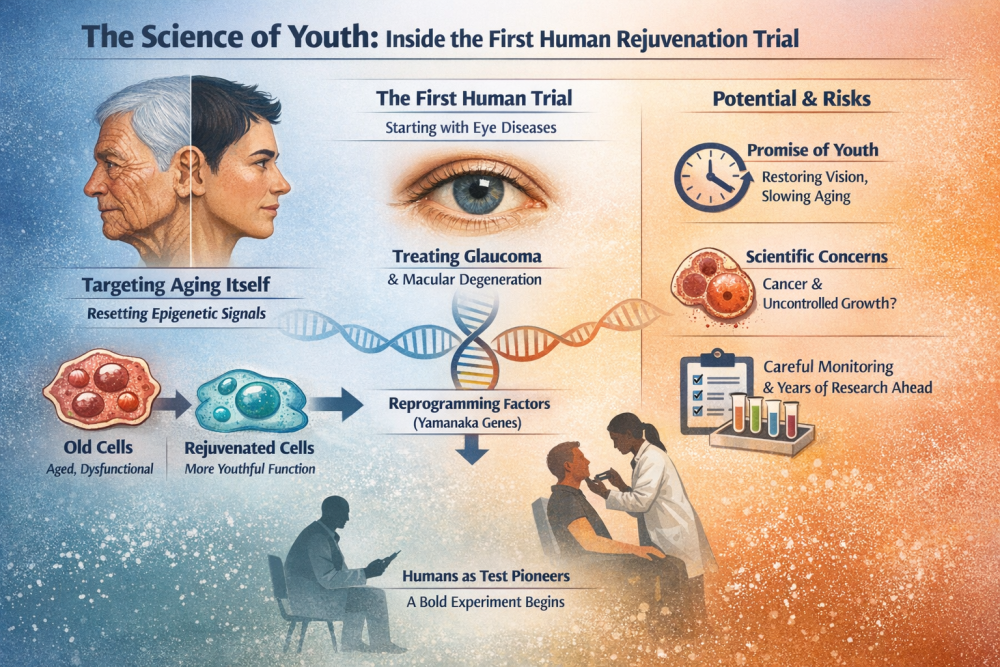
5/2026
In a quiet clinical facility in the United States, a moment that once seemed like science fiction is now happening in real time. Within a few weeks, researchers will begin the first human trial of a treatment designed not just to cure disease but to rejuvenate tissues at a fundamental level, an experiment that challenges our deepest beliefs about aging, health, and what it truly means to grow old. This trial marks a significant step toward understanding and potentially altering the aging process for the general public.
The therapy, code-named ER-100, is being developed by Life Biosciences, a small biotechnology firm spun out of Harvard research. The ER-100 will be used for treating macular degneration. Instead of targeting a single disease, it focuses on aging itself, or more specifically, the epigenetic signals that change as we get older and cause cells to behave less youthfully. This innovative approach aims to address the root causes of aging, potentially transforming future health treatments.
Macular degeneration, most commonly age-related macular degeneration (AMD) is an eye condition that gradually damages the macula, the small but vital central part of the retina responsible for sharp, detailed vision. As the macula deteriorates, individuals have difficulty with reading, recognizing faces, and performing fine tasks, even though their side (peripheral) vision usually remains unaffected.
Epigenetics are chemical switches that determine which of our genes are active and when. They don’t alter our DNA but influence how genes behave like a conductor guiding an orchestra. Over time, these switches accumulate marks that disrupt gene expression and contribute to the decline in tissue function associated with aging. Scientists believe that resetting these patterns could enable older cells to function more like younger ones.
The initial targets for this innovative experiment are eye diseases such as glaucoma, which can cause irreversible vision loss. The method involves precise delivery of reprogramming factors directly into ocular tissue, a strategic decision because the eye’s structure makes localized testing safer and easier to monitor than treatments targeting internal organs.
In animal laboratory studies, similar reprogramming techniques have restored function to aging cells. However, applying this to humans remains uncharted territory. Critics warn that extensive reprogramming poses risks, including the potential for uncontrolled cell growth, a major concern in aging research. Some animal studies have even shown cancerous changes when cells are pushed too far toward a youthful state. These safety concerns highlight the cautious approach scientists are taking before widespread application.
Nonetheless, biotechnology is investing heavily in longevity science. Silicon Valley startups supported by top investors are racing to develop cellular rejuvenation technologies, betting that the future of healthier, longer lives will come from fixing the aging process itself rather than treating diseases individually.
This shift reflects a broader change in how scientists understand aging. Traditionally viewed as an irreversible decline, the inevitable buildup of damage, recent research indicates that aging may also involve a loss of regulatory order within cells. By restoring that balance, old cells could regain aspects of youthful function without losing their identity or turning into stem cells.
Even so, this type of work is still in the early stages. As one longevity expert recently noted in a commentary on emerging science, promising insights into gene networks that control aging are emerging, but much remains unknown. It will take years of careful research before therapies can be safely and broadly used, encouraging patience and responsible optimism.
For the volunteers about to receive the first doses of ER-100, the promise is clear: a chance to preserve sight and see a future where aging itself is treatable. But as the trial begins, researchers and ethicists alike are urging patience. Whatever the outcome, it will take years of careful research before any rejuvenation therapy becomes part of everyday medicine.
In the meantime, the world watches, hopeful yet cautious, as humanity takes its first tentative steps toward understanding the biology of aging.
Disclaimer:
The contents provided on www.biomedglobal.org are intended for general informational and educational purposes only. This website's information, articles, and resources are based on data and findings from scientific publications, publicly available research, and reputable sources.
While every effort is made to ensure accuracy and reliability, Biomed Global does not guarantee, endorse, or assume responsibility for the information's completeness, timeliness, or validity.
The material on this website should not be considered a substitute for professional advice, diagnosis, or treatment. Users are strongly encouraged to consult qualified healthcare professionals, researchers, or subject-matter experts before making decisions based on the information presented here.
Under no circumstances shall Biomed Global, its affiliates, contributors, or authors be held liable for any direct, indirect, incidental, or consequential damages arising from the use of, or reliance on, the content of this website.
By accessing and using www.biomedglobal.org you fully acknowledge and agree to this disclaimer.
Additional Readings