A Programmable DNA-Destroying CRISPR Could Expand Cancer Treatment Options
Posted 6 hours ago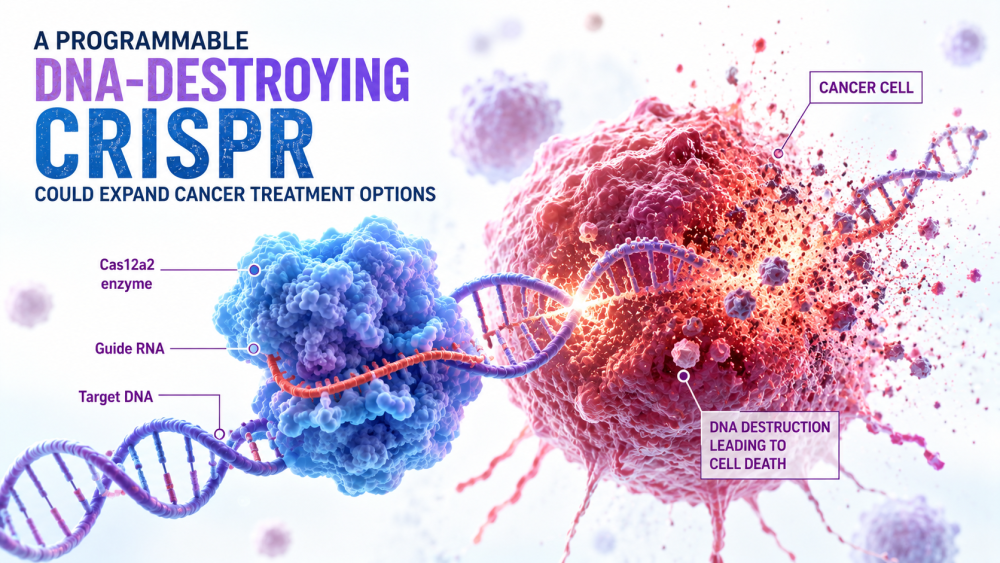
46/2026
For more than a decade, CRISPR (Clustered Regularly Interspaced Short Palindromic Repeats) has been hailed as biology's molecular editor, a technology capable of correcting faulty genes by making exquisitely precise cuts in DNA. But what if, instead of repairing DNA, CRISPR could be repurposed as a microscopic executioner to eliminate faulty cells in the human body?
That is precisely what researchers have now accomplished.
According to a report in Nature Journal, scientists have used a highly unusual CRISPR enzyme to shred a cancer cell's DNA, leaving the cell unable to survive. Early experiments suggest this strategy could target cancers driven by genetic mutations that have long resisted conventional drugs.
A Strange Discovery Hidden Inside Bacteria
CRISPR systems evolved as immune defenses in bacteria, helping them recognize and destroy invading viruses. Most CRISPR enzymes, such as the well-known Cas9, act like molecular scissors that cut DNA at precisely targeted sites. But nearly a decade ago, scientists encountered an oddball enzyme called Cas12a2.
Initially, researchers assumed it would behave like other CRISPR proteins. Instead, their experiments repeatedly failed. Eventually, they realized those failures were revealing something extraordinary.
Once Cas12a2 recognizes its target RNA, it doesn't make a single cut. It goes into a frenzy, slicing DNA throughout the cell. In bacteria, this suicidal response prevents viruses from spreading to neighboring cells. Now the same is being harnessed to kill cancer cells' genetic material, thus obliterating the cancer cells.
What nature evolved as a microbial emergency brake may now become a powerful cancer therapy.
Turning a Bacterial Defense into a Cancer Weapon
Cancer cells differ from healthy cells because they produce abnormal RNA molecules resulting from cancer-causing mutations. Researchers realized they could exploit this difference. Instead of directing Cas12a2 toward viral RNA, they programmed it to recognize RNA unique to cancer cells. When the enzyme detects that molecular signature, it becomes active and rapidly destroys the cell's genome.
The result is not subtle gene editing. It is molecular demolition.
Without an intact genome, the cancer cell activates its own death program, while neighboring healthy cells lacking the targeted RNA remain largely unaffected.
Attacking the "Untouchable" Cancers
One of the most exciting aspects of the discovery is its potential to combat so-called "undruggable" cancers. Many cancers are driven by mutations in genes such as TP53 and KRAS, two of the most notorious cancer genes. Although scientists have spent decades trying to block the abnormal proteins these genes produce, many of these cancers have remained frustratingly resistant to treatment.
The new CRISPR approach bypasses the proteins entirely.
Instead of attacking the protein, it recognizes the mutant RNA that cancer cells produce and uses it as a trigger for self-destruction. This dramatically expands the number of cancers that could eventually be treatable with programmable molecular therapies.
A New Kind of Precision Medicine
Traditional chemotherapy often damages healthy tissues because rapidly dividing normal cells resemble cancer cells. This new technology works differently.
Researchers describe it as a programmable molecular kill switch. The enzyme remains inactive until it encounters the specific RNA sequence linked to a cancer-causing mutation. Only then does it activate its DNA-shredding function. Such selectivity could one day reduce many of chemotherapy's debilitating side effects while increasing treatment precision.
From Laboratory to Patients
Although the technology remains in its early stages, the path toward clinical application has already begun. Akribion Therapeutics, a biotechnology company, is developing therapies based on this approach for human papillomavirus (HPV)-associated head and neck cancers. The company hopes to generate its first clinical trial data before the end of the decade.
A major hurdle, as with other external molecular products, will be that before patients can benefit, researchers must demonstrate that the enzyme can be delivered safely into tumors, avoid unintended damage to healthy cells, and remain effective in the complex environment of the human body. These are substantial challenges, but ones that scientists are actively addressing.
The Bigger Picture
The discovery also underscores an important lesson in scientific research. Many revolutionary technologies emerge not from attempts to directly solve human disease, but from curiosity-driven investigations into how nature works.
Scientists studying bacterial immune systems never expected to discover a molecular weapon capable of destroying cancer cells. Yet decades of fundamental microbiology have repeatedly yielded transformative medical tools from CRISPR gene editing to this newest DNA-shredding strategy.
Nature continues to surprise us.
If future studies confirm its promise, this remarkable CRISPR enzyme may represent not merely another cancer therapy, but an entirely new philosophy of treatment: instead of repairing diseased cells, instruct them to erase themselves.
While describing the promise of this breakthrough, gene therapy expert Prof. Dr. Muhammad Mukhtar, who has previously conducted clinical research in gene therapy and molecular medicine, cautions that several critical challenges remain before this approach can become a routine cancer treatment. Among the most significant are achieving highly targeted delivery of the CRISPR system exclusively to cancer cells, minimizing off-target effects, and enabling the therapeutic molecules to evade or safely modulate the body's immune system, which can rapidly recognize and eliminate foreign biological agents. Overcoming these hurdles, together with demonstrating long-term safety and efficacy in clinical trials, will ultimately determine whether this innovative DNA-destroying CRISPR strategy fulfills its remarkable potential in precision oncology.
Disclaimer:
The contents provided on www.biomedglobal.org are intended for general informational and educational purposes only. This website's information, articles, and resources are based on data and findings from scientific publications, publicly available research, and reputable sources.
While every effort is made to ensure accuracy and reliability, Biomed Global does not guarantee, endorse, or assume responsibility for the completeness, timeliness, or validity of the information.
The material on this website should not be considered a substitute for professional advice, diagnosis, or treatment. Users are strongly encouraged to consult qualified healthcare professionals, researchers, or subject-matter experts before making decisions based on the information presented here.
Under no circumstances shall Biomed Global, its affiliates, contributors, or authors be held liable for any direct, indirect, incidental, or consequential damages arising from the use of, or reliance on, the content of this website.
By accessing and using www.biomedglobal.org, you fully acknowledge and agree to this disclaimer.